
Ch. 5 - Integration
Briggs - Calculus: Early Transcendentals 3rd Edition
Briggs3rd EditionCalculus: Early TranscendentalsISBN: 9780136847243Not the one you use?Change textbook
Chapter 5, Problem 5.5.17

Indefinite integrals Use a change of variables or Table 5.6 to evaluate the following indefinite integrals. Check your work by differentiating.                                                                                  
                                                                                                                                                                    
 βˆ« 2𝓍(𝓍² ― 1)⁹⁹ d𝓍

Verified step by step guidance
1
Step 1: Recognize that the integral ∫ 2𝓍(𝓍² ― 1)⁹⁹ d𝓍 suggests a substitution method. Let u = 𝓍² ― 1, which simplifies the expression inside the parentheses.
Step 2: Compute the derivative of u with respect to 𝓍. Since u = 𝓍² ― 1, we find that du/d𝓍 = 2𝓍. Therefore, du = 2𝓍 d𝓍.
Step 3: Substitute u and du into the integral. Replace 𝓍² ― 1 with u and 2𝓍 d𝓍 with du. The integral becomes ∫ u⁹⁹ du.
Step 4: Apply the power rule for integration. Recall that ∫ uⁿ du = (uⁿ⁺¹)/(n+1) + C, where n β‰  -1. Using this rule, integrate u⁹⁹.
Step 5: Substitute back u = 𝓍² ― 1 into the result to express the solution in terms of 𝓍. Verify your work by differentiating the final expression to ensure it matches the original integrand.

Verified video answer for a similar problem:

This video solution was recommended by our tutors as helpful for the problem above.
Video duration:
3m
Was this helpful?

Key Concepts

Here are the essential concepts you must grasp in order to answer the question correctly.

Indefinite Integrals

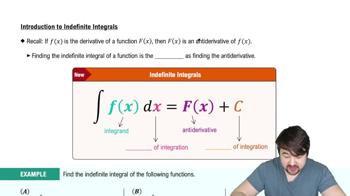
Indefinite integrals represent a family of functions whose derivative is the integrand. They are expressed without limits and include a constant of integration, typically denoted as 'C'. The process of finding an indefinite integral is often referred to as antiderivation, and it is fundamental in calculus for solving problems related to area under curves and accumulation functions.
Recommended video:
05:04
Introduction to Indefinite Integrals

Change of Variables

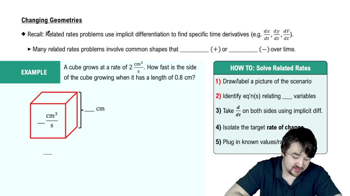
The change of variables technique, also known as substitution, is a method used in integration to simplify the integrand. By substituting a new variable for a function of the original variable, the integral can often be transformed into a more manageable form. This technique is particularly useful when dealing with complex expressions, allowing for easier evaluation of the integral.
Recommended video:
06:35
Changing Geometries

Differentiation Check

Checking work by differentiation involves taking the derivative of the result obtained from an indefinite integral to verify its correctness. This process ensures that the antiderivative found corresponds to the original integrand. If the derivative of the integral result matches the integrand, it confirms that the integration was performed correctly, reinforcing the relationship between differentiation and integration.
Recommended video:
05:02
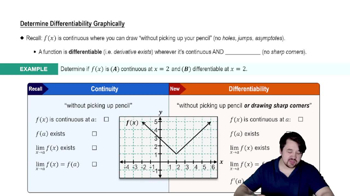
Determining Differentiability Graphically
Related Practice
Textbook Question

Max/min of area functions Suppose Ζ’ is continuous on [0 ,∞) and A(𝓍) is the net area of the region bounded by the graph of Ζ’ and the t-axis on [0, x]. Show that the local maxima and minima of A occur at the zeros of Ζ’. Verify this fact with the function Ζ’(𝓍) = 𝓍² - 10𝓍.

46
views
Textbook Question

Definite integrals Evaluate the following integrals using the Fundamental Theorem of Calculus. Sketch the graph of the integrand and shade the region whose net area you have found.                       


 βˆ«β‚€β΅ (𝓍²―9) d𝓍 

74
views
Textbook Question

Areas of regions Find the area of the following regions.                                                                                                                   

                                                                                                                                                                 The region bounded by the graph of Ζ’(𝓍) = x /√(𝓍² ―9) and the 𝓍-axis between and 𝓍 = 4 and π“= 5

28
views
Textbook Question

Indefinite integrals Use a change of variables or Table 5.6 to evaluate the following indefinite integrals. Check your work by differentiating.                                                                                  


 βˆ« [ 1/(10𝓍―3) d𝓍

57
views
Textbook Question

Suppose an object moves along a line at 15 m/s, for 0 ≀ t < 2 and at 25 m/s, for 2 ≀ t ≀ 5, where t is measured in seconds. Sketch the graph of the velocity function and find the displacement of the object for 0 ≀ t ≀ 5.

47
views
Textbook Question

Definite integrals Use a change of variables or Table 5.6 to evaluate the following definite integrals.                                                                                                                         


 βˆ«β‚€α΅‰Β² (ln p)/p dp

76
views