Ch. 5 - Integration
Briggs - Calculus: Early Transcendentals 3rd Edition
Briggs3rd EditionCalculus: Early TranscendentalsISBN: 9780136847243Not the one you use?Change textbook
Chapter 5, Problem 5.2.83

Limits of sums Use the definition of the definite integral to evaluate the following definite integrals. Use right Riemann sums and Theorem 5.1.


āˆ«ā‚ā“ (š“Ā²ā€•1) dš“

Verified step by step guidance
1
Step 1: Recall the definition of the definite integral using Riemann sums. The definite integral āˆ«ā‚įµ‡ f(x) dx can be approximated by a sum: lim(nā†’āˆž) Ī£įµ¢ā‚Œā‚āæ f(xįµ¢)Ī”x, where Ī”x = (b - a)/n and xįµ¢ = a + iĪ”x for right Riemann sums.
Step 2: Identify the function f(x) = x² - 1, the interval [1, 4], and the number of subintervals n. Calculate Ī”x = (4 - 1)/n = 3/n.
Step 3: Determine the sample points xᵢ for the right Riemann sum. For i = 1, 2, ..., n, xᵢ = 1 + iΔx = 1 + i(3/n).
Step 4: Substitute f(xįµ¢) and Ī”x into the Riemann sum formula. The sum becomes Ī£įµ¢ā‚Œā‚āæ [(xᵢ² - 1) * Ī”x], where xįµ¢ = 1 + i(3/n) and Ī”x = 3/n.
Step 5: Simplify the expression for the sum and take the limit as n → āˆž to evaluate the definite integral. This involves expanding (1 + i(3/n))², simplifying the summation, and using summation formulas for i and i².

Verified video answer for a similar problem:

This video solution was recommended by our tutors as helpful for the problem above.
Video duration:
7m
Was this helpful?

Key Concepts

Here are the essential concepts you must grasp in order to answer the question correctly.

Definite Integral

A definite integral represents the signed area under a curve defined by a function over a specific interval. It is denoted as ∫_a^b f(x) dx, where 'a' and 'b' are the limits of integration. The value of the definite integral can be interpreted as the accumulation of quantities, such as area, over the interval from 'a' to 'b'.
Recommended video:
05:43
Definition of the Definite Integral

Riemann Sums

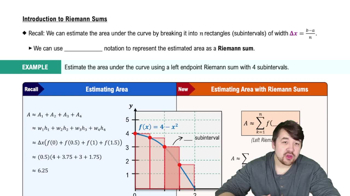
Riemann sums are a method for approximating the value of a definite integral by dividing the area under a curve into rectangles. The sum of the areas of these rectangles, calculated using sample points (like right endpoints), provides an estimate of the integral. As the number of rectangles increases and their width decreases, the Riemann sum approaches the exact value of the definite integral.
Recommended video:
06:11
Introduction to Riemann Sums

Theorem 5.1 (Fundamental Theorem of Calculus)

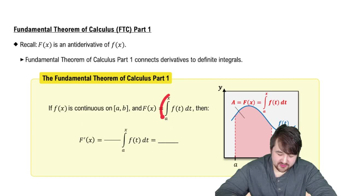
The Fundamental Theorem of Calculus connects differentiation and integration, stating that if a function is continuous on [a, b], then the definite integral of its derivative over that interval equals the difference in the values of the function at the endpoints. This theorem provides a powerful tool for evaluating definite integrals and establishes the relationship between the antiderivative and the area under the curve.
Recommended video:
06:11
Fundamental Theorem of Calculus Part 1
Related Practice
Textbook Question

Use symmetry to explain why.

āˆ«ā“ā‚‹ā‚„ (5š“ā“ + 3š“Ā³ + 2š“Ā² + š“ + 1) dš“ = 2 āˆ«ā‚€ā“ (5š“ā“ + 2š“Ā² + š“ + 1) dš“ .

52
views
Textbook Question

Variations on the substitution method Evaluate the following integrals.                                                                                                        


 āˆ« (š’µ + 1) āˆš(3š’µ + 2) dš’µ

68
views
Textbook Question

Definite integrals Use a change of variables or Table 5.6 to evaluate the following definite integrals.                                                                                                                         


 āˆ«ā‚‚/ā‚ā‚…āˆšā‚ƒā‚Ž^²/⁵ dš“/ x√(25š“Ā²ā€• 1)

38
views
Textbook Question

Gateway Arch The Gateway Arch in St. Louis is 630 ft high and has a 630-ft base. Its shape can be modeled by the parabola y = 630 (1― (š“/315)²) . Find the average height of the arch above the ground.

469
views
Textbook Question

Limits of sums Use the definition of the definite integral to evaluate the following definite integrals. Use right Riemann sums and Theorem 5.1.


āˆ«ā‚€Ā² (2š“ + 1) dš“

91
views
Textbook Question

Displacement from velocity The following functions describe the velocity of a car (in mi/hr) moving along a straight highway for a 3-hr interval. In each case, find the function that gives the displacement of the car over the interval [0,t], where 0 ≤ t ≤ 3.

v(t) = { 30 if 0 ≤ t ≤ 2

50 if 2 < t < 2.5

44 if 2.5 < t ≤ 3

98
views