Ch. 5 - Integration
Briggs - Calculus: Early Transcendentals 3rd Edition
Briggs3rd EditionCalculus: Early TranscendentalsISBN: 9780136847243Not the one you use?Change textbook
Chapter 5, Problem 5.2.55a

Properties of integrals Consider two functions ƒ and g on [1,6] such that ∫₁⁶ƒ(𝓍) d𝓍 = 10 and ∫₁⁶g(𝓍) d𝓍 = 5, ∫₄⁶ƒ(𝓍) d𝓍 = 5 , and ∫₁⁴g(𝓍) d𝓍 = 2. Evaluate the following integrals.


(a) ∫₁⁴ 3f(𝓍) d𝓍

Verified step by step guidance
1
Step 1: Recall the property of integrals that allows constants to be factored out. Specifically, for any constant c and function ƒ(𝓍), ∫ₐᵇ cƒ(𝓍) d𝓍 = c∫ₐᵇ ƒ(𝓍) d𝓍.
Step 2: Apply this property to the given integral ∫₁⁴ 3ƒ(𝓍) d𝓍. Factor out the constant 3, so the integral becomes 3∫₁⁴ ƒ(𝓍) d𝓍.
Step 3: Notice that the integral ∫₁⁴ ƒ(𝓍) d𝓍 is not directly provided in the problem. However, you can calculate it using the additive property of integrals: ∫₁⁶ ƒ(𝓍) d𝓍 = ∫₁⁴ ƒ(𝓍) d𝓍 + ∫₄⁶ ƒ(𝓍) d𝓍.
Step 4: Substitute the known values into the equation. From the problem, ∫₁⁶ ƒ(𝓍) d𝓍 = 10 and ∫₄⁶ ƒ(𝓍) d𝓍 = 5. Solve for ∫₁⁴ ƒ(𝓍) d𝓍 by subtracting: ∫₁⁴ ƒ(𝓍) d𝓍 = 10 - 5.
Step 5: Replace ∫₁⁴ ƒ(𝓍) d𝓍 in the expression 3∫₁⁴ ƒ(𝓍) d𝓍 with the calculated value from Step 4. The final integral is now expressed as 3 multiplied by the result of ∫₁⁴ ƒ(𝓍) d𝓍.

Verified video answer for a similar problem:

This video solution was recommended by our tutors as helpful for the problem above.
Video duration:
2m
Was this helpful?

Key Concepts

Here are the essential concepts you must grasp in order to answer the question correctly.

Properties of Definite Integrals

Definite integrals have several key properties, including linearity, which states that the integral of a sum of functions is the sum of their integrals. Additionally, the integral of a constant multiplied by a function can be factored out, allowing for simplification in calculations. Understanding these properties is essential for evaluating integrals efficiently.
Recommended video:
05:43
Definition of the Definite Integral

Integration of Constant Multiples

When integrating a function multiplied by a constant, the constant can be factored out of the integral. For example, ∫ₐᵇ kƒ(𝓍) d𝓍 = k∫ₐᵇ ƒ(𝓍) d𝓍, where k is a constant. This property simplifies the evaluation of integrals, making it easier to compute the area under the curve of the function multiplied by a constant.
Recommended video:
05:56
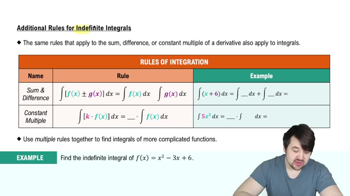
Additional Rules for Indefinite Integrals

Fundamental Theorem of Calculus

The Fundamental Theorem of Calculus connects differentiation and integration, stating that if F is an antiderivative of f on an interval [a, b], then ∫ₐᵇ f(𝓍) d𝓍 = F(b) - F(a). This theorem is crucial for evaluating definite integrals and understanding the relationship between a function and its integral over a specified interval.
Recommended video:
06:11
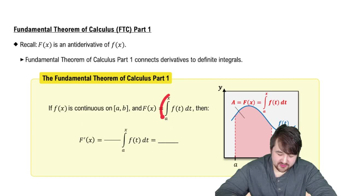
Fundamental Theorem of Calculus Part 1
Related Practice
Textbook Question

Matching functions with area functions Match the functions ƒ, whose graphs are given in a― d, with the area functions A (𝓍) = ∫₀ˣ ƒ(t) dt, whose graphs are given in A–D.


49
views

Textbook Question

{Use of Tech} Approximating definite integrals with a calculator Consider the following definite integrals.

(a) Write the left and right Riemann sums in sigma notation for an arbitrary value of n.


∫₀¹ cos ⁻¹ 𝓍 d𝓍

57
views
Textbook Question

The velocity in ft/s of an object moving along a line is given by v = ƒ(t) on the interval 0 ≤ t ≤ 8 (see figure), where t is measured in seconds.

a) Divide the interval [0,8] into n = 2 subintervals, [0,4] and [4,8]. On each subinterval, assume the object moves at a constant velocity equal to the value of v evaluated at the midpoint of the subinterval, and use these approximations to estimate the displacement of the object on [0,8] (see part (a) of the figure)                                                                                                             


89
views
Textbook Question

Working with area functions Consider the function ƒ and the points a, b, and c.

(a) Find the area function A (𝓍) = ∫ₐˣ ƒ(t) dt using the Fundamental Theorem.

ƒ(𝓍) = ― 12𝓍 (𝓍―1) (𝓍― 2) ; a = 0 , b = 1 , c = 2

51
views
Textbook Question

Average value with a parameter Consider the function ƒ(𝓍) = a𝓍 (1―𝓍) on the interval [0, 1], where a is a positive real number.

(a) Find the average value of ƒ as a function of a .

84
views
Textbook Question

Working with area functions Consider the function ƒ and the points a, b, and c.

(a) Find the area function A (𝓍) = ∫ₐˣ ƒ(t) dt using the Fundamental Theorem.

ƒ(𝓍) = cos 𝓍 ; a = 0 , b = π/2 , c = π

38
views