Ch. 5 - Integration
Briggs - Calculus: Early Transcendentals 3rd Edition
Briggs3rd EditionCalculus: Early TranscendentalsISBN: 9780136847243Not the one you use?Change textbook
Chapter 5, Problem 5.3.8

Why can the constant of integration be omitted from the antiderivative when evaluating a definite integral?

Verified step by step guidance
1
Understand the concept of a definite integral: A definite integral calculates the net area under a curve between two specific bounds, say from x = a to x = b. It results in a numerical value rather than a general function.
Recall the Fundamental Theorem of Calculus: The definite integral of a function f(x) from a to b is computed using an antiderivative F(x), such that \( \int_a^b f(x) \, dx = F(b) - F(a) \).
Recognize the role of the constant of integration: When finding an antiderivative, a constant of integration (C) is added because indefinite integrals represent a family of functions. However, for definite integrals, this constant cancels out during subtraction.
Perform the subtraction step: When evaluating \( F(b) - F(a) \), the constant of integration (C) appears in both F(b) and F(a). Since \( C - C = 0 \), the constant does not affect the final result of the definite integral.
Conclude why the constant can be omitted: Because the constant of integration cancels out during the subtraction process, it is unnecessary to include it when evaluating a definite integral.

Verified video answer for a similar problem:

This video solution was recommended by our tutors as helpful for the problem above.
Video duration:
2m
Was this helpful?

Key Concepts

Here are the essential concepts you must grasp in order to answer the question correctly.

Definite Integral

A definite integral calculates the net area under a curve between two specified limits. It is represented as ∫[a, b] f(x) dx, where 'a' and 'b' are the bounds of integration. The result is a numerical value that reflects the accumulation of quantities, such as area, over the interval [a, b].
Recommended video:
05:43
Definition of the Definite Integral

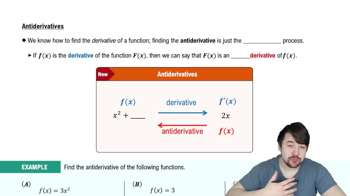
Antiderivative

An antiderivative of a function f(x) is a function F(x) such that F'(x) = f(x). When finding an antiderivative, we often include a constant of integration (C) because the derivative of a constant is zero, meaning multiple functions can yield the same derivative. However, this constant does not affect the evaluation of definite integrals.
Recommended video:
05:50
Antiderivatives

Fundamental Theorem of Calculus

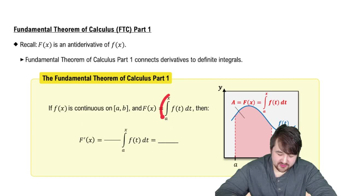
The Fundamental Theorem of Calculus links differentiation and integration, stating that if F is an antiderivative of f on an interval [a, b], then ∫[a, b] f(x) dx = F(b) - F(a). This theorem shows that when evaluating a definite integral, the constant of integration cancels out, as it is present in both F(b) and F(a), making it unnecessary for the final result.
Recommended video:
06:11
Fundamental Theorem of Calculus Part 1
Related Practice
Textbook Question

Definite integrals Use geometry (not Riemann sums) to evaluate the following definite integrals. Sketch a graph of the integrand, show the region in question, and interpret your result.                                                                                                                                      


 ∫₀⁴ (8―2𝓍) d𝓍

86
views

Textbook Question

Indefinite integrals Use a change of variables or Table 5.6 to evaluate the following indefinite integrals. Check your work by differentiating.                                                                                  


 ∫ sin 𝓍 sec⁸ 𝓍 d𝓍

69
views
Textbook Question

Variations on the substitution method Evaluate the following integrals.                                                                                                        


 ∫ y²/(y + 1)⁴ dy

66
views
Textbook Question

Average distance on a parabola What is the average distance between the parabola y = 30𝓍 (20 ― 𝓍 ) and the 𝓍-axis on the interval [0, 20] ?

123
views
Textbook Question

Definite integrals Evaluate the following integrals using the Fundamental Theorem of Calculus


∫₋₂⁻¹ 𝓍⁻³ d𝓍

86
views
Textbook Question

Definite integrals Use a change of variables or Table 5.6 to evaluate the following definite integrals.                                                                                                                         


 ∫₁³ ( 2ˣ / 2ˣ + 4 ) d𝓍

42
views