Determine the area of the shaded region in the following figures.
Ch. 6 - Applications of Integration
Briggs3rd EditionCalculus: Early TranscendentalsISBN: 9780136847243Not the one you use?Change textbook
Chapter 6, Problem 6.1.32
29–36. Position and velocity from acceleration Find the position and velocity of an object moving along a straight line with the given acceleration, initial velocity, and initial position. Use the Fundamental Theorem of Calculus (Theorems 6.1 and 6.2).
a(t) = e^−t; v(0) = 60; s(0) = 40
Verified step by step guidance1
Identify the given acceleration function: \(a(t) = e^{-t}\), the initial velocity \(v(0) = 60\), and the initial position \(s(0) = 40\).
Recall that velocity is the integral of acceleration with respect to time: \(v(t) = \int a(t) \, dt + C_1\). Here, \(C_1\) is the constant of integration that we will find using the initial velocity.
Integrate the acceleration function: \(v(t) = \int e^{-t} \, dt + C_1\). The integral of \(e^{-t}\) is \(-e^{-t}\), so \(v(t) = -e^{-t} + C_1\).
Use the initial velocity condition \(v(0) = 60\) to solve for \(C_1\): substitute \(t=0\) into \(v(t)\) to get \(60 = -e^{0} + C_1\), then solve for \(C_1\).
Next, find the position function by integrating the velocity function: \(s(t) = \int v(t) \, dt + C_2\). Use the initial position \(s(0) = 40\) to solve for the constant of integration \(C_2\).

Verified video answer for a similar problem:
This video solution was recommended by our tutors as helpful for the problem above.
Video duration:
4mWas this helpful?
Key Concepts
Here are the essential concepts you must grasp in order to answer the question correctly.
Acceleration, Velocity, and Position Relationship
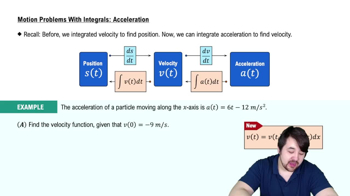
Acceleration is the rate of change of velocity with respect to time, and velocity is the rate of change of position. Given acceleration, velocity can be found by integrating acceleration, and position can be found by integrating velocity. Initial conditions help determine the constants of integration.
Recommended video:
Using The Acceleration Function
Fundamental Theorem of Calculus
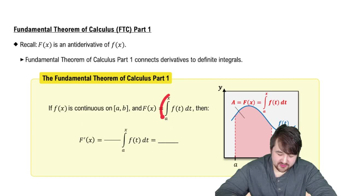
The Fundamental Theorem of Calculus links differentiation and integration, stating that integration can be reversed by differentiation. It allows us to find a function from its derivative by integrating, and use initial values to solve for constants, which is essential when finding velocity and position from acceleration.
Recommended video:
Fundamental Theorem of Calculus Part 1
Initial Conditions in Differential Equations
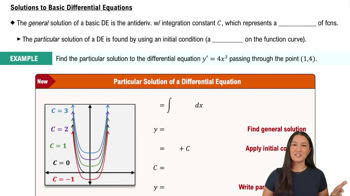
Initial conditions specify the value of a function at a particular point, enabling the determination of integration constants after integrating. For motion problems, initial velocity and position are used to find the exact velocity and position functions from their derivatives.
Recommended video:
Solutions to Basic Differential Equations
Related Practice
Textbook Question
145
views
Textbook Question
64–68. Shell method Use the shell method to find the volume of the following solids.
A hole of radius r≤R is drilled symmetrically along the axis of a bullet. The bullet is formed by revolving the parabola y = 6(1−x²/R²) about the y-axis, where 0≤x≤R.
108
views
Textbook Question
Determine the area of the shaded region in the following figures.
52
views
Textbook Question
A solid has a circular base; cross sections perpendicular to the base are squares. What method should be used to find the volume of the solid?
145
views
Textbook Question
Why is the disk method a special case of the general slicing method?
100
views
Textbook Question
Work from force How much work is required to move an object from x=1 to x=3 (measured in meters) in the presence of a force (in N) given by F(x) = 2x² acting along the x-axis?
84
views