Emptying a partially filled swimming pool If the water in the swimming pool in Exercise 35 is 2 m deep, then how much work is required to pump all the water to a level 3 m above the bottom of the pool?
Ch. 6 - Applications of Integration
Briggs3rd EditionCalculus: Early TranscendentalsISBN: 9780136847243Not the one you use?Change textbook
Chapter 6, Problem 6.4.25
9-34. Shell method Let R be the region bounded by the following curves. Use the shell method to find the volume of the solid generated when R is revolved about indicated axis.
{Use of Tech} y = 1 / (x² + 1)²,y=0,x=1, and x=2; about the y-axis
Verified step by step guidance1
Identify the region R bounded by the curves: \( y = \frac{1}{(x^2 + 1)^2} \), \( y = 0 \), \( x = 1 \), and \( x = 2 \). This region lies between \( x = 1 \) and \( x = 2 \) above the x-axis and under the curve \( y = \frac{1}{(x^2 + 1)^2} \).
Since the solid is generated by revolving the region about the y-axis, use the shell method. The shell method formula for volume when revolving around the y-axis is:
\[ V = 2\pi \int_{a}^{b} (\text{radius})(\text{height}) \, dx \]
where the radius is the distance from the y-axis to the shell (which is \( x \)) and the height is the function value \( y = \frac{1}{(x^2 + 1)^2} \).
Set up the integral with the limits of integration from \( x = 1 \) to \( x = 2 \):
\[ V = 2\pi \int_{1}^{2} x \cdot \frac{1}{(x^2 + 1)^2} \, dx \]
Simplify the integrand if possible. Here, the integrand is \( \frac{x}{(x^2 + 1)^2} \). Consider using substitution to evaluate the integral later, such as letting \( u = x^2 + 1 \), which implies \( du = 2x \, dx \).
After setting up the integral, proceed to evaluate it using the substitution method or other integration techniques. Finally, multiply the result by \( 2\pi \) to find the volume of the solid.

Verified video answer for a similar problem:
This video solution was recommended by our tutors as helpful for the problem above.
Video duration:
5mWas this helpful?
Key Concepts
Here are the essential concepts you must grasp in order to answer the question correctly.
Shell Method for Volume
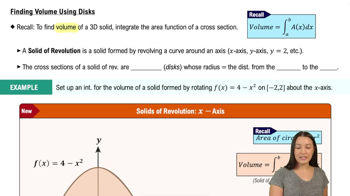
The shell method calculates the volume of a solid of revolution by integrating cylindrical shells. Each shell's volume is found by multiplying its circumference, height, and thickness. This method is especially useful when revolving a region around an axis parallel to the axis of the variable of integration.
Recommended video:
Finding Volume Using Disks
Setting up the Integral with Given Bounds
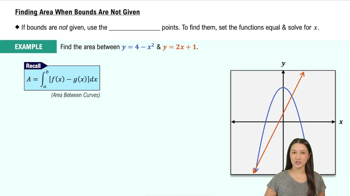
To apply the shell method, identify the radius and height of each shell based on the region's boundaries. Here, the radius is the distance from the y-axis (the axis of rotation) to x, and the height is given by the function y = 1/(x² + 1)². The bounds for x are from 1 to 2, defining the limits of integration.
Recommended video:
Finding Area When Bounds Are Not Given
Understanding the Function and Region
The function y = 1/(x² + 1)² describes the upper boundary of the region, while y = 0, x = 1, and x = 2 form the other boundaries. Recognizing these curves helps visualize the region being revolved and ensures correct interpretation of the height and limits in the integral.
Recommended video:
Area of Polar Regions
Related Practice
Textbook Question
46
views
Textbook Question
Function defined as an integral Write the integral that gives the length of the curve y = f(x) = ∫₀^x sin t dt on the interval [0,π]
55
views
Textbook Question
Let R be the region bounded by the following curves. Find the volume of the solid generated when R is revolved about the given axis.
y=sin xon [0,π] and y=0 ; about the x-axis (Hint: Recall that sin^2 x=1 − cos2x / 2.
71
views
Textbook Question
Find the area of the region described in the following exercises.
The region bounded by y=4x+4, y=6x+6, and x=4
74
views
Textbook Question
9–20. Arc length calculations Find the arc length of the following curves on the given interval.
x = 2e^√2y + 1/16e^−√2y, for 0 ≤ y ≤ ln²/√2
56
views
Textbook Question
13–20. Mass of one-dimensional objects Find the mass of the following thin bars with the given density function.
ρ(x) = 5e^-2x,for 0≤x≤4
49
views