Ch. 6 - Applications of Integration
Briggs - Calculus: Early Transcendentals 3rd Edition
Briggs3rd EditionCalculus: Early TranscendentalsISBN: 9780136847243Not the one you use?Change textbook
Chapter 6, Problem 6.5.19

9–20. Arc length calculations Find the arc length of the following curves on the given interval.
x = 2y−4, for −3≤y≤4 (Use calculus, but check your work using geometry.)

Verified step by step guidance
1
Rewrite the given curve equation in terms of \( y \): \( x = 2y - 4 \). Since \( x \) is expressed as a function of \( y \), we will use the arc length formula with respect to \( y \).
Recall the arc length formula for a curve \( x = f(y) \) from \( y = a \) to \( y = b \): \[ L = \int_{a}^{b} \sqrt{1 + \left( \frac{dx}{dy} \right)^2} \, dy \]
Calculate the derivative \( \frac{dx}{dy} \) from the given function: \[ \frac{dx}{dy} = \frac{d}{dy}(2y - 4) = 2 \]
Substitute \( \frac{dx}{dy} = 2 \) into the arc length integral and set the limits from \( y = -3 \) to \( y = 4 \): \[ L = \int_{-3}^{4} \sqrt{1 + (2)^2} \, dy = \int_{-3}^{4} \sqrt{1 + 4} \, dy = \int_{-3}^{4} \sqrt{5} \, dy \]
Evaluate the integral by factoring out the constant \( \sqrt{5} \): \[ L = \sqrt{5} \int_{-3}^{4} dy = \sqrt{5} [y]_{-3}^{4} = \sqrt{5} (4 - (-3)) = \sqrt{5} \times 7 \] This gives the arc length in terms of \( \sqrt{5} \) and the interval length.

Verified video answer for a similar problem:

This video solution was recommended by our tutors as helpful for the problem above.
Video duration:
1m
Was this helpful?

Key Concepts

Here are the essential concepts you must grasp in order to answer the question correctly.

Arc Length Formula

The arc length of a curve defined by a function can be found using the integral formula: L = ∫√(1 + (dy/dx)²) dx or L = ∫√(1 + (dx/dy)²) dy, depending on the variable of integration. This formula sums infinitesimal line segments along the curve to find its total length.
Recommended video:
06:29
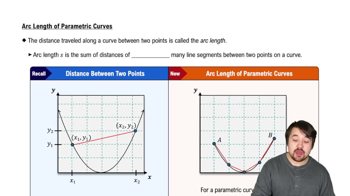
Arc Length of Parametric Curves

Parametric and Implicit Differentiation

When the curve is given in terms of y or implicitly, it is important to correctly find the derivative dx/dy or dy/dx. This may involve rearranging the equation or using implicit differentiation to express the derivative needed for the arc length formula.
Recommended video:
06:49
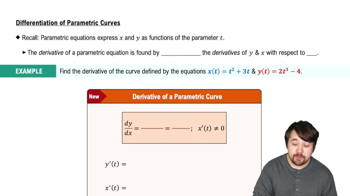
Differentiation of Parametric Curves

Geometric Interpretation and Verification

After calculating the arc length using calculus, it is useful to verify the result geometrically if possible. For linear or simple curves, the arc length corresponds to the distance between endpoints, providing a way to check the correctness of the integral calculation.
Recommended video:
Guided course
04:18
Geometric Sequences - Recursive Formula
Related Practice
Textbook Question

13–20. Mass of one-dimensional objects Find the mass of the following thin bars with the given density function.


ρ(x) = {x² if 0≤x≤1 {x(2-x) if 1<x≤2

59
views

Textbook Question

Work from force How much work is required to move an object from x=0 to x=3 (measured in meters) in the presence of a force (in N) given by F(x)=2x acting along the x-axis?

48
views
Textbook Question

Drinking juice A glass has circular cross sections that taper (linearly) from a radius of 5 cm at the top of the glass to a radius of 4 cm at the bottom. The glass is 15 cm high and full of orange juice. How much work is required to drink all the juice through a straw if your mouth is 5 cm above the top of the glass? Assume the density of orange juice equals the density of water.

62
views
Textbook Question

3–6. Setting up arc length integrals Write and simplify, but do not evaluate, an integral with respect to x that gives the length of the following curves on the given interval.

y = 2 cos 3x on [−π,π]

72
views
Textbook Question

46–50. Force on dams The following figures show the shapes and dimensions of small dams. Assuming the water level is at the top of the dam, find the total force on the face of the dam.

79
views
Textbook Question

The region R is bounded by the graph of f(x)=2x(2−x) and the x-axis. Which is greater, the volume of the solid generated when R is revolved about the line y=2 or the volume of the solid generated when R is revolved about the line y=0? Use integration to justify your answer.

49
views