
Ch. 6 - Applications of Integration
Briggs - Calculus: Early Transcendentals 3rd Edition
Briggs3rd EditionCalculus: Early TranscendentalsISBN: 9780136847243Not the one you use?Change textbook
Chapter 6, Problem 6.1.37e

Acceleration A drag racer accelerates at a(t)=88 ft/s². Assume v(0)=0, s(0)=0, and t is measured in seconds.


e. How far has the racer traveled when it reaches a speed of 178 ft/s?

Verified step by step guidance
1
Identify the given information: acceleration \(a(t) = 88\) ft/s² (constant), initial velocity \(v(0) = 0\) ft/s, and initial position \(s(0) = 0\) ft.
Since acceleration is the derivative of velocity, express velocity as the integral of acceleration: \(v(t) = \int a(t) \, dt = \int 88 \, dt\).
Integrate the acceleration to find velocity: \(v(t) = 88t + C\). Use the initial condition \(v(0) = 0\) to solve for \(C\), which gives \(C = 0\), so \(v(t) = 88t\).
Use the velocity function to find the time \(t\) when the velocity reaches 178 ft/s by solving \(178 = 88t\) for \(t\).
Next, find the position function \(s(t)\) by integrating the velocity: \(s(t) = \int v(t) \, dt = \int 88t \, dt\). Use the initial condition \(s(0) = 0\) to find the constant of integration, then evaluate \(s(t)\) at the time found in the previous step to determine the distance traveled.

Verified video answer for a similar problem:

This video solution was recommended by our tutors as helpful for the problem above.
Video duration:
4m
Was this helpful?

Key Concepts

Here are the essential concepts you must grasp in order to answer the question correctly.

Relationship Between Acceleration, Velocity, and Displacement

Acceleration is the rate of change of velocity with respect to time, and velocity is the rate of change of displacement. Understanding how to integrate acceleration to find velocity, and then integrate velocity to find displacement, is essential for solving motion problems.
Recommended video:
08:56
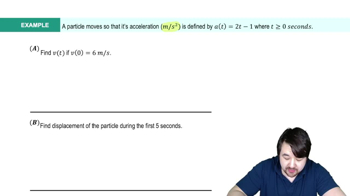
Using The Acceleration Function Example 1

Integration of Constant Acceleration

When acceleration is constant, velocity can be found by integrating acceleration over time, resulting in a linear function of time. Similarly, displacement is found by integrating velocity, yielding a quadratic function. This process allows calculation of position and velocity at any time.
Recommended video:
08:14
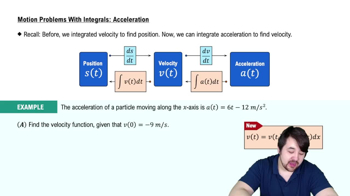
Using The Acceleration Function

Using Initial Conditions to Determine Constants

Initial conditions like v(0)=0 and s(0)=0 provide values to solve for integration constants after integrating acceleration and velocity. Applying these conditions ensures the solution accurately models the physical scenario from the given starting point.
Recommended video:
06:46
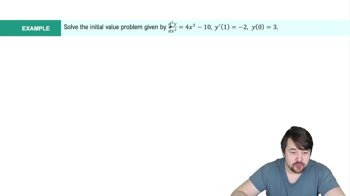
Initial Value Problems Example 1
Related Practice
Textbook Question

Bike race Theo and Sasha start at the same place on a straight road, riding bikes with the following velocities (measured in mi/hr). Assume t is measured in hours.

Theo: vT(t)=10, for t≥0

Sasha: vS(t)=15t, for 0≤t≤1, and vS(t)=15, for t>1


f. Suppose Sasha gives Theo a head start of 0.2 hr and the riders ride for 20 mi. Who wins the race?

33
views
Textbook Question

Displacement and distance from velocity Consider the velocity function shown below of an object moving along a line. Assume time is measured in seconds and distance is measured in meters. The areas of four regions bounded by the velocity curve and the t-axis are also given.


e. Describe the position of the object relative to its initial position after 8 seconds.

61
views
Textbook Question

Use the region R that is bounded by the graphs of y=1+√x,x=4, and y=1 complete the exercises.


Region R is revolved about the x-axis to form a solid of revolution whose cross sections are washers.


d. Write an integral for the volume of the solid.

126
views
Textbook Question

Displacement and distance from velocity Consider the graph shown in the figure, which gives the velocity of an object moving along a line. Assume time is measured in hours and distance is measured in miles. The areas of three regions bounded by the velocity curve and the t-axis are also given.

d. What is the displacement of the object over the interval [0,5]?

117
views
Textbook Question

Determine whether the following statements are true and give an explanation or counterexample. 


d. Let f(x)=12x^2.. The area of the surface generated when the graph of f on [−4, 4] is revolved about the y-axis is twice the area of the surface generated when the graph of f on [0, 4] is revolved about the y-axis.

56
views