Ch. 6 - Applications of Integration
Briggs - Calculus: Early Transcendentals 3rd Edition
Briggs3rd EditionCalculus: Early TranscendentalsISBN: 9780136847243Not the one you use?Change textbook
Chapter 6, Problem 6.R.34b

Area and volume The region R is bounded by the curves x = y²+2,y=x−4, and y=0 (see figure).
b. Write a single integral that gives the volume of the solid generated when R is revolved about the x-axis.

Verified step by step guidance
1
First, identify the region R bounded by the curves: \( x = y^2 + 2 \), \( y = x - 4 \), and \( y = 0 \). Sketching or visualizing these curves helps understand the limits of integration and the shape of the region.
Since the solid is generated by revolving the region R about the x-axis, consider using the method of cylindrical shells or washers/disks. Here, using the washer method with respect to \( y \) is convenient because the boundaries are given in terms of \( y \) and \( x \).
Express the volume element as a washer with inner radius and outer radius measured from the x-axis. The outer radius is the distance from the x-axis to the upper curve, and the inner radius is the distance from the x-axis to the lower curve within the region. Since \( y = 0 \) is one boundary, the radius will be \( y \) itself.
Determine the limits of integration for \( y \) by finding the intersection points of the curves in terms of \( y \). Solve for the values of \( y \) where the curves intersect to establish the bounds of integration.
Set up the integral for the volume using the washer method formula: \[ V = \pi \int_{a}^{b} \left( R_{outer}(y)^2 - R_{inner}(y)^2 \right) \, dy \], where \( R_{outer}(y) \) and \( R_{inner}(y) \) are the outer and inner radii of the washers. Express these radii in terms of \( y \) using the given curves.

Verified video answer for a similar problem:

This video solution was recommended by our tutors as helpful for the problem above.
Video duration:
6m
Was this helpful?

Key Concepts

Here are the essential concepts you must grasp in order to answer the question correctly.

Region Bounded by Curves

Understanding the region R requires identifying the area enclosed by the given curves. This involves finding the points of intersection and determining which curve lies above or below within the interval. Properly sketching or visualizing the region helps set up integrals accurately.
Recommended video:
05:06
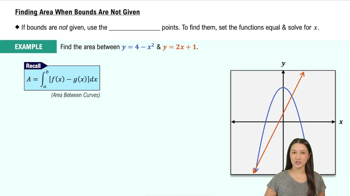
Finding Area When Bounds Are Not Given

Volume of Solids of Revolution

When a region is revolved around an axis, it generates a 3D solid. The volume can be found using methods like the disk/washer or shell method, which involve integrating cross-sectional areas perpendicular to the axis of rotation.
Recommended video:
04:48
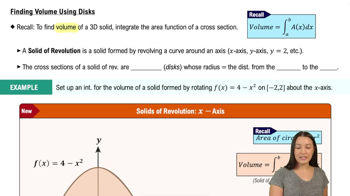
Finding Volume Using Disks

Setting up a Single Integral for Volume

To write a single integral for volume, one must express the radius and limits of integration in terms of a single variable. This often requires rewriting curves and choosing the appropriate method (disk/washer or shell) to represent the volume as an integral with clear bounds.
Recommended video:
05:38
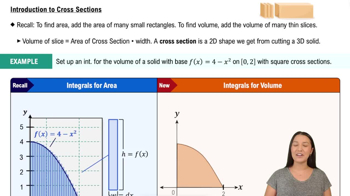
Introduction to Cross Sections
Related Practice
Textbook Question

58–61. Arc length Find the length of the following curves.

y = 2x+4 on [−2,2] (Use calculus.)

51
views

Textbook Question

43–55. Volumes of solids Choose the general slicing method, the disk/washer method, or the shell method to answer the following questions.


The region bounded by the graphs of y = 2x,y = 6−x, and y = 0 is revolved about the line y = −2 and the line x = −2. Find the volumes of the resulting solids. Which one is greater?

71
views
Textbook Question

35-38. Area and volume Let R be the region in the first quadrant bounded by the graph of

Find the area of the region R.

63
views
Textbook Question

Variable gravity At Earth’s surface, the acceleration due to gravity is approximately g=9.8 m/s² (with local variations). However, the acceleration decreases with distance from the surface according to Newton’s law of gravitation. At a distance of y meters from Earth’s surface, the acceleration is given by a(y) = - g / (1+y/R)², where R=6.4×10⁶ m is the radius of Earth.


f. Graph ymax as a function of v0. What is the maximum height when v0=500 m/s,1500 m/s, and 5 km/s?

88
views
Textbook Question

Explain why or why not Determine whether the following statements are true and give an explanation or counterexample.

b. Given only the velocity of an object moving on a line, it is possible to find its displacement, but not its position.

47
views
Textbook Question

Fuel consumption A small plane in flight consumes fuel at a rate (in gal/min) given by

R'(t) ={ 4t^{1/3} if 0 ≤ t ≤ 8 (take-off)

2 if t> 0 (cruising)

a. Find a function R that gives the total fuel consumed, for 0≤t≤8.

64
views