Ch. 6 - Applications of Integration
Briggs - Calculus: Early Transcendentals 3rd Edition
Briggs3rd EditionCalculus: Early TranscendentalsISBN: 9780136847243Not the one you use?Change textbook
Chapter 6, Problem 6.7.23c

Compressing and stretching a spring Suppose a force of 30 N is required to stretch and hold a spring 0.2 m from its equilibrium position.
c. How much work is required to stretch the spring 0.3 m from its equilibrium position?

Verified step by step guidance
1
Identify the spring constant \( k \) using Hooke's Law, which states that the force \( F \) required to stretch or compress a spring is proportional to the displacement \( x \) from its equilibrium position: \( F = kx \). Given \( F = 30 \) N and \( x = 0.2 \) m, solve for \( k \) by rearranging the formula to \( k = \frac{F}{x} \).
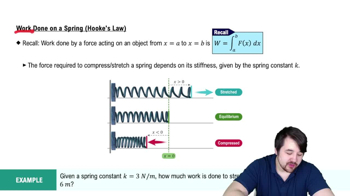
Recall that the work \( W \) done in stretching or compressing a spring from the equilibrium position to a displacement \( x \) is given by the integral of the force over the distance, which results in the formula \( W = \frac{1}{2}kx^2 \).
Use the value of \( k \) found in step 1 and substitute \( x = 0.3 \) m into the work formula \( W = \frac{1}{2}kx^2 \) to set up the expression for the work required to stretch the spring 0.3 m.
Write down the expression explicitly: \( W = \frac{1}{2} \times k \times (0.3)^2 \), where \( k \) is the spring constant calculated earlier.
Evaluate the expression to find the amount of work required to stretch the spring 0.3 m, remembering that this value represents the energy stored in the spring due to the stretching.

Verified video answer for a similar problem:

This video solution was recommended by our tutors as helpful for the problem above.
Video duration:
2m
Was this helpful?

Key Concepts

Here are the essential concepts you must grasp in order to answer the question correctly.

Hooke's Law

Hooke's Law states that the force needed to stretch or compress a spring is proportional to the displacement from its equilibrium position, expressed as F = kx, where k is the spring constant and x is the displacement. This law helps determine the spring constant from given force and displacement values.
Recommended video:
05:40
Work Done On A Spring (Hooke's Law)

Spring Constant

The spring constant (k) measures the stiffness of a spring and is calculated by dividing the applied force by the displacement (k = F/x). Knowing k allows us to quantify how much force is needed for any given stretch or compression of the spring.
Recommended video:
05:40
Work Done On A Spring (Hooke's Law)

Work Done by a Variable Force

Work done in stretching a spring is calculated by integrating the force over the displacement, since the force varies with position. The work done to stretch a spring from 0 to x is W = (1/2)kx², representing the area under the force-displacement curve.
Recommended video:
05:40
Work Done On A Spring (Hooke's Law)
Related Practice
Textbook Question

Piecewise velocity The velocity of a (fast) automobile on a straight highway is given by the function

v(t)={3t if 0t<2060 if 20t<452404t if t45v(t)= \(\begin{cases}\)3 t & \(\text\) { if } 0 \(\leq\) t<20 \\ 60 & \(\text\) { if } 20 \(\leq\) t<45 \\ 240-4 t & \(\text\) { if } t \(\geq\) 45\(\end{cases}\)

, where is measured in seconds and v has units of m/s. 


c. What is the distance traveled by the automobile in the first 60 s?

68
views
Textbook Question

Determine whether the following statements are true and give an explanation or counterexample. 


c. Let f(x)=12x^2. The area of the surface generated when the graph of f on [−4, 4] is revolved about the x-axis is twice the area of the surface generated when the graph of f on [0, 4] is revolved about the x-axis. 

65
views
Textbook Question

Let R be the region in the first quadrant bounded above by the curve y=2−x² and bounded below by the line y=x. Suppose the shell method is used to determine the volume of the solid generated by revolving R about the y-axis.

c. Write an integral for the volume of the solid using the shell method.

59
views
Textbook Question

Probe speed A data collection probe is dropped from a stationary balloon, and it falls with a velocity (in m/s) given by v(t) = 9.8t, neglecting air resistance. After 10 s, a chute deploys and the probe immediately slows to a constant speed of 10 m/s, which it maintains until it enters the ocean.


c. If the probe was released from an altitude of 3 km, when does it enter the ocean?

46
views
Textbook Question

9–10. Velocity graphs The figures show velocity functions for motion along a line. Assume the motion begins with an initial position of s(0)=0. Determine the following.

c. The position at t=5

51
views
Textbook Question

Flow rates in the Spokane River The daily discharge of the Spokane River as it flows through Spokane, Washington, in April and June is modeled by the functions

r1(t) = 0.25t²+37.46t+722.47 (April) and

r2(t) = 0.90t²−69.06t+2053.12 (June), where the discharge is measured in millions of cubic feet per day, and t=0 corresponds to the beginning of the first day of the month (see figure).

c. The Spokane River flows out of Lake Coeur d’Alene, which contains approximately 0.67mi³ of water. Determine the percentage of Lake Coeur d’Alene’s volume that flows through Spokane in April and June.

32
views