


Ch. 6 - Applications of Integration
Briggs - Calculus: Early Transcendentals 3rd Edition
Briggs3rd EditionCalculus: Early TranscendentalsISBN: 9780136847243Not the one you use?Change textbook
Chapter 6, Problem 6.1.47c

Depletion of natural resources Suppose r(t) = r0e^−kt, with k>0, is the rate at which a nation extracts oil, where r0=10⁷ barrels/yr is the current rate of extraction. Suppose also that the estimate of the total oil reserve is 2×10⁹ barrels. 


c. Find the minimum decay constant k for which the total oil reserves will last forever.

Verified step by step guidance
1
Understand the problem: The extraction rate is given by the function \(r(t) = r_0 e^{-kt}\), where \(r_0 = 10^7\) barrels/year and \(k > 0\) is the decay constant. The total oil reserve is \(2 \times 10^9\) barrels. We want to find the minimum value of \(k\) such that the total extracted oil over infinite time does not exceed the reserve.
Set up the integral for total oil extracted over time from \(t=0\) to \(t=\infty\): \(\displaystyle \int_0^{\infty} r(t) \, dt = \int_0^{\infty} r_0 e^{-kt} \, dt\).
Evaluate the integral: Since \(r_0\) is constant, factor it out: \(r_0 \int_0^{\infty} e^{-kt} \, dt\). The integral of \(e^{-kt}\) from 0 to infinity is \(\frac{1}{k}\), so the total extracted oil is \(\frac{r_0}{k}\).
Apply the condition that the total extracted oil must be less than or equal to the total reserve: \(\frac{r_0}{k} \leq 2 \times 10^9\) barrels.
Solve the inequality for \(k\): Rearranging gives \(k \geq \frac{r_0}{2 \times 10^9}\). Substitute \(r_0 = 10^7\) to find the minimum decay constant \(k\).

Verified video answer for a similar problem:

This video solution was recommended by our tutors as helpful for the problem above.
Video duration:
4m
Was this helpful?

Key Concepts

Here are the essential concepts you must grasp in order to answer the question correctly.

Exponential Decay Function

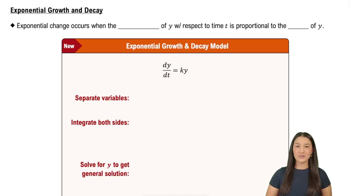
An exponential decay function models quantities that decrease at a rate proportional to their current value. Here, r(t) = r0e^(-kt) represents the rate of oil extraction decreasing over time, where k > 0 controls how fast the rate declines. Understanding this helps analyze how extraction slows and affects total resource depletion.
Recommended video:
09:29
Exponential Growth & Decay

Definite Integral and Total Quantity Extracted

The total amount of oil extracted over time is found by integrating the rate function r(t) from zero to infinity. This integral sums all infinitesimal extractions, allowing us to compare the total extracted oil to the reserve limit. Mastery of definite integrals is essential to solve for conditions on k.
Recommended video:
05:43
Definition of the Definite Integral

Convergence of Improper Integrals

Since the extraction rate decreases exponentially, the integral from zero to infinity is an improper integral. Determining whether this integral converges (i.e., has a finite value) is crucial to ensure the total extracted oil does not exceed the reserve. This concept helps find the minimum decay constant k for sustainable extraction.
Recommended video:
11:11
Improper Integrals: Infinite Intervals
Related Practice
Textbook Question

Where do they meet? Kelly started at noon (t=0) riding a bike from Niwot to Berthoud, a distance of 20 km, with velocity v(t) = 15 / (t + 1)² (decreasing because of fatigue). Sandy started at noon (t=0) riding a bike in the opposite direction from Berthoud to Niwot with velocity u(t) = 20 / (t + 1)² (also decreasing because of fatigue). Assume distance is measured in kilometers and time is measured in hours.


c. When do they meet? How far has each person traveled when they meet?

44
views
Textbook Question

Explain why or why not Determine whether the following statements are true and give an explanation or counterexample.

c. If a region is revolved about the x-axis, then in principle, it is possible to use the disk/washer method and integrate with respect to x or to use the shell method and integrate with respect to y.

63
views
Textbook Question

Let R be the region bounded by the curve y=√cos x and the x-axis on [0, π/2]. A solid of revolution is obtained by revolving R about the x-axis (see figures). 


c. Write an integral for the volume of the solid.

64
views
Textbook Question

Blood flow A typical human heart pumps 70 mL of blood (the stroke volume) with each beat. Assuming a heart rate of 60 beats/min (1 beat/s), a reasonable model for the outflow rate of the heart is V′(t)=70(1+sin 2πt), where V(t) is the amount of blood (in milliliters) pumped over the interval [0,t],V(0)=0 and t is measured in seconds.


c. What is the cardiac output over a period of 1 min? (Use calculus; then check your answer with algebra.)

97
views
Textbook Question

Distance traveled and displacement Suppose an object moves along a line with velocity (in ft/s) v(t)=6−2t, for 0≤t≤6, where t is measured in seconds.


c. Find the distance traveled by the object on the interval 0≤t≤6.

26
views
Textbook Question

9–10. Velocity graphs The figures show velocity functions for motion along a line. Assume the motion begins with an initial position of s(0)=0. Determine the following.

c. The position at t=5

40
views