Ch. 6 - Applications of Integration
Briggs - Calculus: Early Transcendentals 3rd Edition
Briggs3rd EditionCalculus: Early TranscendentalsISBN: 9780136847243Not the one you use?Change textbook
Chapter 6, Problem 6.1.7a

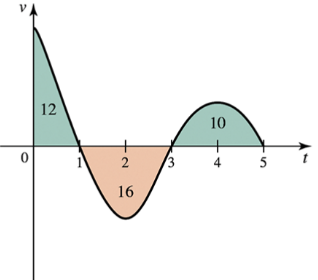
Displacement and distance from velocity Consider the graph shown in the figure, which gives the velocity of an object moving along a line. Assume time is measured in hours and distance is measured in miles. The areas of three regions bounded by the velocity curve and the t-axis are also given.
img
a. On what intervals is the object moving in the positive direction?

Verified step by step guidance
1
Understand that the velocity graph shows how the velocity of the object changes over time, with the horizontal axis representing time (t) in hours and the vertical axis representing velocity (v) in miles per hour.
Recall that when the velocity is positive (above the t-axis), the object is moving in the positive direction, and when the velocity is negative (below the t-axis), the object is moving in the negative direction.
Identify the intervals on the time axis where the velocity curve is above the t-axis. From the graph, the velocity is positive from t = 0 to t = 1 and from t = 3 to t = 5.
Note that between t = 1 and t = 3, the velocity is negative (below the t-axis), so the object is moving in the negative direction during this interval.
Conclude that the object is moving in the positive direction on the intervals where the velocity is positive, which are t in [0, 1] and t in [3, 5].

Verified video answer for a similar problem:

This video solution was recommended by our tutors as helpful for the problem above.
Video duration:
1m
Was this helpful?

Key Concepts

Here are the essential concepts you must grasp in order to answer the question correctly.

Velocity and Direction of Motion

Velocity indicates both the speed and direction of an object's movement. When velocity is positive, the object moves in the positive direction along the line; when velocity is negative, the object moves in the opposite direction. Understanding the sign of velocity helps determine intervals of motion direction.
Recommended video:
06:29
Derivatives Applied To Velocity

Area Under the Velocity Curve

The area between the velocity curve and the time-axis represents the displacement over a time interval. Positive areas correspond to movement in the positive direction, while negative areas correspond to movement in the negative direction. These areas help quantify how far and in which direction the object has moved.
Recommended video:
05:59
Estimating the Area Under a Curve with Right Endpoints & Midpoint

Intervals of Time and Sign Changes

The velocity graph crosses the time-axis at points where velocity changes sign, indicating a change in direction. Identifying these points allows us to determine intervals where the velocity is positive or negative, which directly relates to the object's direction of motion.
Recommended video:
06:35
Changing Geometries
Related Practice
Textbook Question

Consider the following curves on the given intervals.  


a. Write the integral that gives the area of the surface generated when the curve is revolved about the given axis. 


y=tan x , for 0≤x≤π/4; about the x-axis 

100
views

Textbook Question

Explain why or why not Determine whether the following statements are true and give an explanation or counterexample.

a. When using the shell method, the axis of the cylindrical shells is parallel to the axis of revolution.

53
views
Textbook Question

Bike race Theo and Sasha start at the same place on a straight road, riding bikes with the following velocities (measured in mi/hr). Assume t is measured in hours.

Theo: vT(t)=10, for t≥0

Sasha: vS(t)=15t, for 0≤t≤1, and vS(t)=15, for t>1


a. Graph the velocity function for both riders. 

28
views
Textbook Question

21–30. {Use of Tech} Arc length by calculator


a. Write and simplify the integral that gives the arc length of the following curves on the given interval. 

y = cos 2x, for 0 ≤ x ≤ π

64
views
Textbook Question

Calculating work for different springs Calculate the work required to stretch the following springs 1.25 m from their equilibrium positions. Assume Hooke’s law is obeyed.

a. A spring that requires 100 J of work to be stretched 0.5 m from its equilibrium position

71
views
Textbook Question

21–30. {Use of Tech} Arc length by calculator


a. Write and simplify the integral that gives the arc length of the following curves on the given interval. 

y = ln x, for 1≤x≤4

39
views