

Ch. 6 - Applications of Integration
Briggs - Calculus: Early Transcendentals 3rd Edition
Briggs3rd EditionCalculus: Early TranscendentalsISBN: 9780136847243Not the one you use?Change textbook
Chapter 6, Problem 6.1.7b

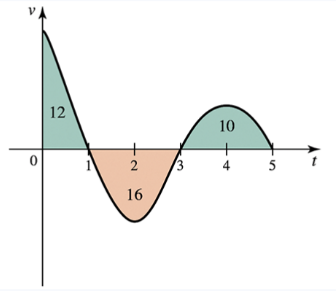
Displacement and distance from velocity Consider the graph shown in the figure, which gives the velocity of an object moving along a line. Assume time is measured in hours and distance is measured in miles. The areas of three regions bounded by the velocity curve and the t-axis are also given.
img
b. What is the displacement of the object over the interval [0,3]?

Verified step by step guidance
1
Understand that displacement over a time interval is given by the definite integral of the velocity function over that interval. In this case, displacement from time \(t=0\) to \(t=3\) is the integral of velocity \(v(t)\) from 0 to 3.
Identify the areas under the velocity curve between \(t=0\) and \(t=3\) from the graph. The graph shows two regions: one above the \(t\)-axis from \(t=0\) to \(t=1\) with area 12, and one below the \(t\)-axis from \(t=1\) to \(t=3\) with area 16.
Recall that areas above the \(t\)-axis correspond to positive velocity (positive contribution to displacement), and areas below the \(t\)-axis correspond to negative velocity (negative contribution to displacement).
Calculate the net displacement by subtracting the area below the \(t\)-axis from the area above the \(t\)-axis over the interval \([0,3]\). This means displacement = (area above) - (area below) = 12 - 16.
Express the displacement as the net signed area under the velocity curve from \(t=0\) to \(t=3\), which represents the total change in position of the object during this time.

Verified video answer for a similar problem:

This video solution was recommended by our tutors as helpful for the problem above.
Video duration:
2m
Was this helpful?

Key Concepts

Here are the essential concepts you must grasp in order to answer the question correctly.

Velocity and Displacement

Velocity represents the rate of change of position with respect to time. Displacement over a time interval is the net change in position, calculated as the integral of velocity over that interval. Positive velocity contributes to forward displacement, while negative velocity contributes to backward displacement.
Recommended video:
10:17
Using The Velocity Function

Definite Integral as Area Under the Curve

The definite integral of a velocity function over a time interval corresponds to the net area between the velocity curve and the time axis. Areas above the axis are positive, and areas below are negative, reflecting direction. This integral gives the displacement, not the total distance traveled.
Recommended video:
05:43
Definition of the Definite Integral

Difference Between Displacement and Distance

Displacement is the net change in position and can be positive, negative, or zero, depending on direction. Distance is the total length traveled, always positive, and equals the sum of the absolute values of areas under the velocity curve. Understanding this distinction is crucial for interpreting velocity graphs.
Recommended video:
02:59
Finding Area Between Curves that Cross on the Interval
Related Practice
Textbook Question

Emptying a cylindrical tank A cylindrical water tank has height 8 m and radius 2m (see figure).

b. Is it true that it takes half as much work to pump the water out of the tank when it is half full as when it is full? Explain.

108
views
Textbook Question

Explain why or why not Determine whether the following statements are true and give an explanation or counterexample.


b. If a region is revolved about the y-axis, then the shell method must be used.

47
views
Textbook Question

A nonlinear spring Hooke’s law is applicable to idealized (linear) springs that are not stretched or compressed too far from their equilibrium positions. Consider a nonlinear spring whose restoring force is given by F(x) = 16x−0.1x³, for |x|≤7. 

b. How much work is done in stretching the spring from its equilibrium position (x=0) to x=1.5?

68
views
Textbook Question

Volumes without calculus Solve the following problems with and without calculus. A good picture helps.


b. A cube is inscribed in a right circular cone with a radius of 1 and a height of 3. What is the volume of the cube?

63
views
Textbook Question

Functions from arc length What differentiable functions have an arc length on the interval [a, b] given by the following integrals? Note that the answers are not unique. Give a family of functions that satisfy the conditions.

b. ∫a^b √1+36 cos² 2xdx

68
views
Textbook Question

Determine whether the following statements are true and give an explanation or counterexample. 


b. If f is not one-to-one on the interval [a, b], then the area of the surface generated when the graph of f on [a, b] is revolved about the x-axis is not defined.

42
views