
Ch. 6 - Applications of Integration
Briggs - Calculus: Early Transcendentals 3rd Edition
Briggs3rd EditionCalculus: Early TranscendentalsISBN: 9780136847243Not the one you use?Change textbook
Chapter 6, Problem 6.7.39a

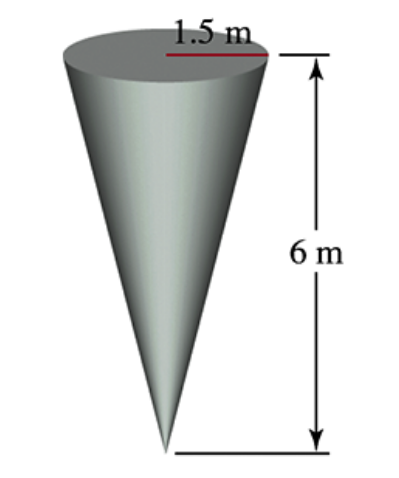
Emptying a conical tank A water tank is shaped like an inverted cone with height 6 m and base radius 1.5 m (see figure).
a. If the tank is full, how much work is required to pump the water to the level of the top of the tank and out of the tank?
<IMAGE>

Verified step by step guidance
1
Identify the variables and set up the coordinate system: Let the vertical axis y measure the height from the tip (vertex) of the cone upwards, with y = 0 at the tip and y = 6 m at the top of the tank.
Express the radius of the water surface at height y: Since the tank is a cone, the radius r at height y varies linearly from 0 at y = 0 to 1.5 m at y = 6 m. Use similar triangles to write the radius as a function of y: \(r(y) = \frac{1.5}{6} y = 0.25 y\).
Write the volume of a thin horizontal slice of water at height y: The slice has thickness \(dy\) and radius \(r(y)\), so its volume is \(dV = \pi [r(y)]^2 dy = \pi (0.25 y)^2 dy = \pi \times 0.0625 y^2 dy\).
Determine the work required to pump this slice of water to the top: The weight density of water is \(\rho g\) (where \(\rho\) is the density of water and \(g\) is acceleration due to gravity). The distance the slice must be lifted is \(6 - y\). So the work to move this slice is \(dW = \rho g \times dV \times (6 - y)\).
Set up the integral for total work: Integrate \(dW\) from \(y = 0\) to \(y = 6\) to find the total work required to pump all the water out of the tank: \(W = \int_0^6 \rho g \pi (0.0625 y^2) (6 - y) dy\). This integral can then be evaluated to find the total work.

Verified video answer for a similar problem:

This video solution was recommended by our tutors as helpful for the problem above.
Video duration:
4m
Was this helpful?

Key Concepts

Here are the essential concepts you must grasp in order to answer the question correctly.

Work Done by a Variable Force

Work is the integral of force over distance. When pumping water from a tank, the force varies with the weight of the water slice being moved and the distance it must be lifted. Calculating work involves integrating the product of force and displacement over the height of the tank.
Recommended video:
05:40
Work Done On A Spring (Hooke's Law)

Volume of a Thin Slice of Water in a Cone

To find the work done, the tank is divided into thin horizontal slices of water. Each slice is a thin disk whose radius depends on its height in the cone. Using similar triangles, the radius at any height can be expressed as a function of height, allowing calculation of the slice's volume.
Recommended video:
05:38
Introduction to Cross Sections

Relationship Between Radius and Height in a Cone

The radius of the water slice changes linearly with height due to the conical shape. Using the given dimensions, the radius at height y can be found by proportionality: radius = (1.5/6) * y. This relationship is essential to express the volume and weight of each slice as functions of height.
Recommended video:
05:23
Finding Area Between Curves on a Given Interval
Related Practice
Textbook Question

40–43. Population growth


A culture of bacteria in a Petri dish has an initial population of 1500 cells and grows at a rate (in cells/day) of N′(t) = 100e^−0.25t. Assume t is measured in days.


a. What is the population after 20 days? After 40 days?

42
views
Textbook Question

17–22. Position from velocity Consider an object moving along a line with the given velocity v and initial position.


a. Determine the position function, for t≥0, using the antiderivative method


v(t) = −t³+3t²−2t on [0, 3]; s(0)=4

33
views
Textbook Question

55–58. Marginal cost Consider the following marginal cost functions.


a. Find the additional cost incurred in dollars when production is increased from 100 units to 150 units.


C′(x) = 300+10x−0.01x²

89
views
Textbook Question

Blood flow A typical human heart pumps 70 mL of blood (the stroke volume) with each beat. Assuming a heart rate of 60 beats/min (1 beat/s), a reasonable model for the outflow rate of the heart is V′(t)=70(1+sin 2πt), where V(t) is the amount of blood (in milliliters) pumped over the interval [0,t],V(0)=0 and t is measured in seconds.


a. Verify that the amount of blood pumped over a one-second interval is 70 mL.

162
views
Textbook Question

{Use of Tech} Oscillating motion A mass hanging from a spring is set in motion, and its ensuing velocity is given by v(t) = 2π cos πt, for t≥0. Assume the positive direction is upward and s(0)=0. 


a. Determine the position function, for t≥0.

68
views
Textbook Question

For the given regions R₁ and R₂, complete the following steps.


a. Find the area of region R₁.


R₁ is the region in the first quadrant bounded by the y-axis and the curves y=2x^2 and y=3−x; R₂ is the region in the first quadrant bounded by the x-axis and the curves y=2x^2 and y=3−x(see figure).

47
views