
Ch. 6 - Applications of Integration
Briggs - Calculus: Early Transcendentals 3rd Edition
Briggs3rd EditionCalculus: Early TranscendentalsISBN: 9780136847243Not the one you use?Change textbook
Chapter 6, Problem 6.1.59a

Explain why or why not Determine whether the following statements are true and give an explanation or counterexample.


a. The distance traveled by an object moving along a line is the same as the displacement of the object.

Verified step by step guidance
1
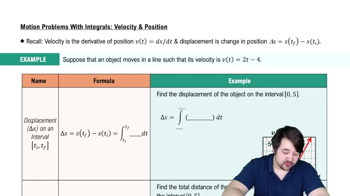
Recall the definitions: Displacement is the change in position of an object, calculated as the final position minus the initial position, and it is a vector quantity (it has direction). Distance traveled is the total length of the path taken by the object, which is a scalar quantity (only magnitude, no direction).
Understand that displacement can be zero if the object returns to its starting point, but the distance traveled will be the total length covered, which is generally not zero in this case.
Consider an example: if an object moves 5 meters to the right and then 5 meters back to the left, the displacement is zero (because the final position equals the initial position), but the distance traveled is 10 meters (5 + 5).
From this example, conclude that the distance traveled and displacement are not always the same; distance traveled is always greater than or equal to the magnitude of displacement.
Therefore, the statement 'The distance traveled by an object moving along a line is the same as the displacement of the object' is false, and the counterexample above demonstrates why.

Verified video answer for a similar problem:

This video solution was recommended by our tutors as helpful for the problem above.
Video duration:
2m
Was this helpful?

Key Concepts

Here are the essential concepts you must grasp in order to answer the question correctly.

Displacement

Displacement is a vector quantity that represents the change in position of an object from its starting point to its ending point, considering direction. It is calculated as the straight-line distance between the initial and final positions, regardless of the path taken.
Recommended video:
10:17
Using The Velocity Function

Distance Traveled

Distance traveled is a scalar quantity that measures the total length of the path an object moves along, without considering direction. It accounts for all movement, including any backtracking or detours, and is always equal to or greater than the magnitude of displacement.
Recommended video:
06:22
Introduction To Work

Difference Between Distance and Displacement

Distance and displacement differ because displacement only considers the net change in position, while distance sums the entire path length. For example, if an object moves forward and then back to the start, displacement is zero, but distance traveled is positive, showing they are not always equal.
Recommended video:
02:59
Finding Area Between Curves that Cross on the Interval
Related Practice