
Textbook Question
9-34. Shell method Let R be the region bounded by the following curves. Use the shell method to find the volume of the solid generated when R is revolved about indicated axis.
x = x³ ,y = 1, and x = 0; about the x-axis
47
views

 Verified step by step guidance
 07:06
07:06
 06:35
06:35 07:45
07:459-34. Shell method Let R be the region bounded by the following curves. Use the shell method to find the volume of the solid generated when R is revolved about indicated axis.
x = x³ ,y = 1, and x = 0; about the x-axis
29–36. Position and velocity from acceleration Find the position and velocity of an object moving along a straight line with the given acceleration, initial velocity, and initial position. Use the Fundamental Theorem of Calculus (Theorems 6.1 and 6.2).
a(t) = −32; v(0)=50; s(0)=0
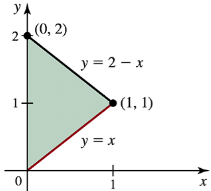
Look again at the region R in Figure 6.38 (p. 439). Explain why it would be difficult to use the washer method to find the volume of the solid of revolution that results when R is revolved about the y-axis.
Suppose the region bounded by the curve y=f(x) from x=0 to x=4 (see figure) is revolved about the x-axis to form a solid of revolution. Use left, right, and midpoint Riemann sums, with n=4 subintervals of equal length, to estimate the volume of the solid of revolution.
Use the general slicing method to find the volume of the following solids.
The solid whose base is the region bounded by the curves y=x^2 and y=2−x^2, and whose cross sections through the solid perpendicular to the x-axis are squares
35–38. Shell and washer methods Let R be the region bounded by the following curves. Use both the shell method and the washer method to find the volume of the solid generated when R is revolved about the indicated axis.
y = 8,y = 2x+2,x = 0, and x=2; about the y-axis