Ch. 6 - Applications of Integration
Briggs - Calculus: Early Transcendentals 3rd Edition
Briggs3rd EditionCalculus: Early TranscendentalsISBN: 9780136847243Not the one you use?Change textbook
Chapter 6, Problem 6.R.12a

{Use of Tech} Decreasing velocity A projectile is fired upward, and its velocity (in m/s) is given by v(t) = 200 / √t+1, for t≥0.
a. Graph the velocity function, for t≥0.

Verified step by step guidance
1
Understand the function: The velocity function given is v(t) = 200 / √(t+1). This represents how the velocity of the projectile changes over time, t, where t is greater than or equal to 0.
Identify the domain: Since the function involves a square root, ensure that the expression inside the square root is non-negative. Here, t+1 is always positive for t ≥ 0, so the domain is t ≥ 0.
Consider the behavior of the function: As t increases, the denominator √(t+1) increases, which means the overall value of v(t) decreases. This indicates that the velocity decreases as time progresses.
Graph the function: To graph v(t), plot points for various values of t starting from t = 0. Calculate v(t) for these values to get a sense of the curve. For example, at t = 0, v(0) = 200 / √(0+1) = 200. As t increases, compute v(t) for t = 1, 2, 3, etc., to see how the velocity decreases.
Analyze the graph: Observe that the graph starts at v(0) = 200 and decreases as t increases. The graph will be a curve that approaches the t-axis but never touches it, reflecting the decreasing velocity over time.

Verified video answer for a similar problem:

This video solution was recommended by our tutors as helpful for the problem above.
Video duration:
2m
Was this helpful?

Key Concepts

Here are the essential concepts you must grasp in order to answer the question correctly.

Velocity Function

The velocity function describes the rate of change of an object's position with respect to time. In this case, the function v(t) = 200 / √(t+1) indicates how the velocity of the projectile changes as time progresses. Understanding this function is crucial for analyzing the motion of the projectile and determining its behavior over time.
Recommended video:
06:29
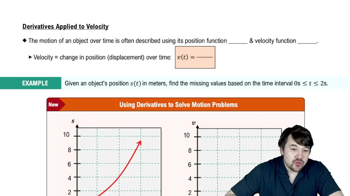
Derivatives Applied To Velocity

Graphing Functions

Graphing a function involves plotting its values on a coordinate system to visualize its behavior. For the velocity function v(t), this means calculating v(t) for various values of t and plotting these points to observe how velocity changes as time increases. This graphical representation helps in understanding trends, such as whether the velocity is increasing or decreasing.
Recommended video:
5:53
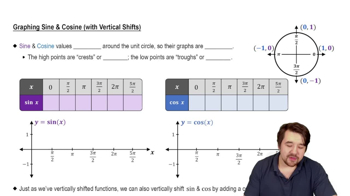
Graph of Sine and Cosine Function

Limits and Asymptotic Behavior

Limits are fundamental in calculus for understanding the behavior of functions as they approach specific points or infinity. In the context of the velocity function, analyzing limits can reveal how the velocity behaves as time t increases indefinitely. This concept is essential for predicting long-term behavior and understanding the implications of decreasing velocity in projectile motion.
Recommended video:
03:07
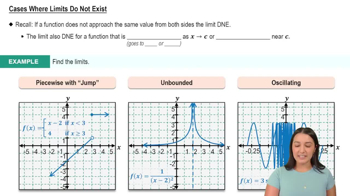
Cases Where Limits Do Not Exist