
Ch. 6 - Applications of Integration
Briggs - Calculus: Early Transcendentals 3rd Edition
Briggs3rd EditionCalculus: Early TranscendentalsISBN: 9780136847243Not the one you use?Change textbook
Chapter 6, Problem 6.1.64d

Where do they meet? Kelly started at noon (t=0) riding a bike from Niwot to Berthoud, a distance of 20 km, with velocity v(t) = 15 / (t + 1)² (decreasing because of fatigue). Sandy started at noon (t=0) riding a bike in the opposite direction from Berthoud to Niwot with velocity u(t) = 20 / (t + 1)² (also decreasing because of fatigue). Assume distance is measured in kilometers and time is measured in hours.


d. More generally, if the riders’ speeds are v(t)=A(t+1)² and u(t)=B(t+1)² and the distance between the towns is D, what conditions on A, B, and D must be met to ensure that the riders will pass each other?

Verified step by step guidance
1
First, understand that the riders start at opposite ends of a distance \(D\) kilometers apart and move towards each other. Their positions as functions of time \(t\) (in hours) can be found by integrating their velocity functions, since velocity is the derivative of position with respect to time.
Express the position of Kelly starting from Niwot as \(x_K(t) = \int_0^t v(s) \, ds\), where \(v(t) = \frac{A}{(t+1)^2}\). Similarly, express Sandy's position starting from Berthoud as \(x_S(t) = D - \int_0^t u(s) \, ds\), where \(u(t) = \frac{B}{(t+1)^2}\). Note that Sandy's position decreases from \(D\) towards 0.
Calculate the integrals for both riders: \(\int_0^t \frac{A}{(s+1)^2} ds\) and \(\int_0^t \frac{B}{(s+1)^2} ds\). Recall that \(\int \frac{1}{(s+1)^2} ds = -\frac{1}{s+1} + C\). Use this to find explicit expressions for \(x_K(t)\) and \(x_S(t)\).
Set the positions equal to find the meeting time \(t^*\): \(x_K(t^*) = x_S(t^*)\). This gives an equation involving \(A\), \(B\), \(D\), and \(t^*\) that can be solved to find when and if they meet.
To ensure the riders pass each other, the meeting time \(t^*\) must be a positive real number. Analyze the equation to find the condition on \(A\), \(B\), and \(D\) that guarantees such a \(t^*\) exists. This typically means the combined distance they cover over time must be at least \(D\).

Verified video answer for a similar problem:

This video solution was recommended by our tutors as helpful for the problem above.
Video duration:
9m
Was this helpful?

Key Concepts

Here are the essential concepts you must grasp in order to answer the question correctly.

Position as an Integral of Velocity

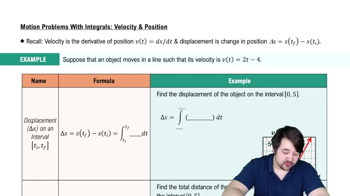
The position of each rider over time is found by integrating their velocity functions. Since velocity varies with time, integrating v(t) or u(t) from 0 to t gives the distance traveled from the starting point. This allows us to express each rider's location as a function of time, essential for determining when and where they meet.
Recommended video:
10:17
Using The Velocity Function

Meeting Condition Based on Total Distance

The riders meet when the sum of the distances each has traveled equals the total distance D between the towns. Mathematically, this means the integral of v(t) plus the integral of u(t) from 0 to the meeting time t equals D. Understanding this condition helps set up an equation to solve for the meeting time.
Recommended video:
6:13
Exponential Functions

Convergence of Improper Integrals and Parameter Constraints

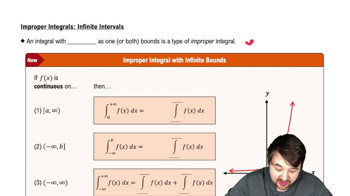
To ensure the riders actually meet, the combined distances traveled over infinite time must be at least D. This involves analyzing the improper integrals of v(t) and u(t) as t approaches infinity. The parameters A, B, and D must satisfy conditions so that the total possible distance covered is at least D, guaranteeing the riders pass each other.
Recommended video:
11:11
Improper Integrals: Infinite Intervals
Related Practice
Textbook Question

Explain why or why not Determine whether the following statements are true and give an explanation or counterexample.


d. A particular marginal cost function has the property that it is positive and decreasing. The cost of increasing production from A units to 2A units is greater than the cost of increasing production from 2A units to 3A units.

43
views
Textbook Question

Displacement and distance from velocity Consider the velocity function shown below of an object moving along a line. Assume time is measured in seconds and distance is measured in meters. The areas of four regions bounded by the velocity curve and the t-axis are also given.

d. What is the displacement of the object over the interval [0, 8]? 

75
views
Textbook Question

Compressing and stretching a spring Suppose a force of 30 N is required to stretch and hold a spring 0.2 m from its equilibrium position.

d. How much additional work is required to stretch the spring 0.2m if it has already been stretched 0.2m from its equilibrium position?

59
views
Textbook Question

Piecewise velocity The velocity of a (fast) automobile on a straight highway is given by the function

v(t)={3t if 0t<2060 if 20t<452404t if t45v(t)= \(\begin{cases}\)3 t & \(\text\) { if } 0 \(\leq\) t<20 \\ 60 & \(\text\) { if } 20 \(\leq\) t<45 \\ 240-4 t & \(\text\) { if } t \(\geq\) 45\(\end{cases}\)

where is measured in seconds and v has units of m/s. 

d. What is the position of the automobile when t=75?

48
views
Textbook Question

Displacement and distance from velocity Consider the graph shown in the figure, which gives the velocity of an object moving along a line. Assume time is measured in hours and distance is measured in miles. The areas of three regions bounded by the velocity curve and the t-axis are also given.

d. What is the displacement of the object over the interval [0,5]?

117
views
Textbook Question

Determine whether the following statements are true and give an explanation or counterexample. 


d. Let f(x)=12x^2.. The area of the surface generated when the graph of f on [−4, 4] is revolved about the y-axis is twice the area of the surface generated when the graph of f on [0, 4] is revolved about the y-axis.

56
views