Ch. 7 - Logarithmic, Exponential Functions, and Hyperbolic Functions
Briggs - Calculus: Early Transcendentals 3rd Edition
Briggs3rd EditionCalculus: Early TranscendentalsISBN: 9780136847243Not the one you use?Change textbook
Chapter 7, Problem 7.2.45a

Chemotherapy In an experimental study at Dartmouth College, mice with tumors were treated with the chemotherapeutic drug Cisplatin. Before treatment, the tumors consisted entirely of clonogenic cells that divide rapidly, causing the tumors to double in size every 2.9 days. Immediately after treatment, 99% of the cells in the tumor became quiescent cells which do not divide and lose 50% of their volume every 5.7 days. For a particular mouse, assume the tumor size is 0.5 cm³ at the time of treatment.
a. Find an exponential decay function V₁(t) that equals the total volume of the quiescent cells in the tumor t days after treatment.

Verified step by step guidance
1
Identify the initial volume of the quiescent cells immediately after treatment. Since 99% of the tumor cells become quiescent, multiply the total tumor volume at treatment (0.5 cm³) by 0.99 to find the initial volume of quiescent cells: \(V_0 = 0.5 \times 0.99\) cm³.
Recognize that the quiescent cells decrease in volume exponentially over time, losing 50% of their volume every 5.7 days. This means the volume halves every 5.7 days, which is a characteristic of exponential decay.
Write the general form of the exponential decay function for volume \(V_1(t)\) as: \(V_1(t) = V_0 \times 2^{-\frac{t}{T}}\) where \(T\) is the half-life (5.7 days) and \(t\) is the time in days after treatment.
Substitute the known values into the formula: \(V_1(t) = (0.5 \times 0.99) \times 2^{-\frac{t}{5.7}}\).
This function \(V_1(t)\) now models the total volume of quiescent cells in the tumor at any time \(t\) days after treatment.

Verified video answer for a similar problem:

This video solution was recommended by our tutors as helpful for the problem above.
Video duration:
2m
Was this helpful?

Key Concepts

Here are the essential concepts you must grasp in order to answer the question correctly.

Exponential Decay Function

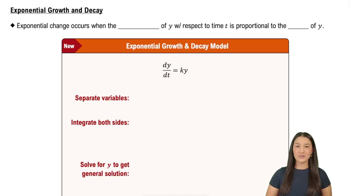
An exponential decay function models quantities that decrease at a rate proportional to their current value. It has the form V(t) = V₀ * e^(-kt), where V₀ is the initial amount, k is the decay constant, and t is time. This concept is essential for describing how the volume of quiescent cells decreases over time.
Recommended video:
09:29
Exponential Growth & Decay

Decay Constant and Half-Life Relationship

The decay constant k relates to the half-life (the time it takes for a quantity to reduce to half) by the formula k = ln(2) / half-life. Knowing the half-life allows calculation of k, which is necessary to define the exponential decay function accurately.
Recommended video:
09:29
Exponential Growth & Decay

Initial Conditions and Volume Partitioning

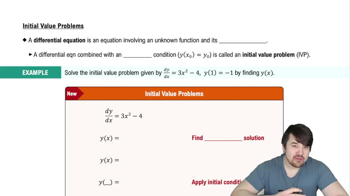
Understanding the initial tumor volume and the proportion of cells that become quiescent immediately after treatment is crucial. Here, 99% of the tumor volume becomes quiescent, so the initial volume for the decay function is 99% of 0.5 cm³. This sets the starting point for modeling volume decay.
Recommended video:
05:03
Initial Value Problems
Related Practice
Textbook Question

Visual approximation


a. Use a graphing utility to sketch the graph of y = coth x and then explain why ∫₅¹⁰ coth x dx ≈ 5.

42
views

Textbook Question

Zero net area Consider the function f(x) = (1 − x)/x

a. Are there numbers 0 < a < 1 such that ∫₁₋ₐ¹⁺ᵃ f(x) dx = 0?

34
views
Textbook Question

Velocity of falling body Refer to Exercise 95, which gives the position function for a falling body. Use m = 75 kg and k = 0.2.


a. Confirm that the BASE jumper’s velocity t seconds after jumping is v(t) = d'(t) = √(mg/k) tanh (√(kg/m) t).

40
views
Textbook Question

Terminal velocity Refer to Exercises 95 and 96.


a. Compute a jumper’s terminal velocity, which is defined as lim t → ∞ v(t) = lim t → ∞ √(mg/k) tanh (√(kg/m) t).

65
views
Textbook Question

Evaluating hyperbolic functions Evaluate each expression without using a calculator or state that the value does not exist. Simplify answers as much as possible.


a. cosh 0

59
views
Textbook Question

Falling body When an object falling from rest encounters air resistance proportional to the square of its velocity, the distance it falls (in meters) after t seconds is given by d(t) = (m/k) ln (cosh (√(kg/m) t)), where m is the mass of the object in kilograms, g = 9.8 m/s² is the acceleration due to gravity, and k is a physical constant.


a. A BASE jumper (m = 75 kg) leaps from a tall cliff and performs a ten-second delay (she free-falls for 10 s and then opens her chute). How far does she fall in 10 s? Assume k = 0.2.

54
views