Ch. 7 - Logarithmic, Exponential Functions, and Hyperbolic Functions
Briggs - Calculus: Early Transcendentals 3rd Edition
Briggs3rd EditionCalculus: Early TranscendentalsISBN: 9780136847243Not the one you use?Change textbook
Chapter 7, Problem 7.1.68

Logarithm properties Use the integral definition of the natural logarithm to prove that ln(x/y) = ln x - ln y.

Verified step by step guidance
1
Recall the integral definition of the natural logarithm: for any positive number \( a \), \( \ln a = \int_1^a \frac{1}{t} \, dt \).
Express \( \ln \left( \frac{x}{y} \right) \) using the integral definition: \( \ln \left( \frac{x}{y} \right) = \int_1^{\frac{x}{y}} \frac{1}{t} \, dt \).
Use a substitution to rewrite the integral with limits from 1 to \( x \) and 1 to \( y \). Let \( t = \frac{u}{y} \), so that when \( t = 1 \), \( u = y \), and when \( t = \frac{x}{y} \), \( u = x \).
Rewrite the integral in terms of \( u \): \( \int_1^{\frac{x}{y}} \frac{1}{t} \, dt = \int_y^x \frac{1}{\frac{u}{y}} \cdot \frac{1}{y} \, du = \int_y^x \frac{y}{u} \cdot \frac{1}{y} \, du = \int_y^x \frac{1}{u} \, du \).
Split the integral \( \int_y^x \frac{1}{u} \, du \) into \( \int_1^x \frac{1}{u} \, du - \int_1^y \frac{1}{u} \, du \), which equals \( \ln x - \ln y \), thus proving \( \ln \left( \frac{x}{y} \right) = \ln x - \ln y \).

Verified video answer for a similar problem:

This video solution was recommended by our tutors as helpful for the problem above.
Video duration:
3m
Was this helpful?

Key Concepts

Here are the essential concepts you must grasp in order to answer the question correctly.

Integral Definition of the Natural Logarithm

The natural logarithm ln(x) can be defined as the integral from 1 to x of 1/t dt. This definition provides a fundamental way to understand ln(x) using calculus, linking logarithms to areas under curves.
Recommended video:
05:43
Definition of the Definite Integral

Properties of Definite Integrals

Definite integrals have properties such as additivity over adjacent intervals and the ability to split or combine integrals. These properties allow manipulation of integrals to express ln(x/y) in terms of ln(x) and ln(y).
Recommended video:
05:43
Definition of the Definite Integral

Logarithm Laws and Their Proofs

Logarithm laws, like ln(x/y) = ln(x) - ln(y), describe relationships between logarithms of products and quotients. Using the integral definition and integral properties, these laws can be rigorously proven rather than assumed.
Recommended video:
7:30
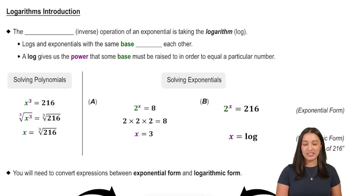
Logarithms Introduction
Related Practice
Textbook Question

Catenary arch The portion of the curve y =17/15 - cosh x that lies above the x-axis forms a catenary arch. Find the average height of the arch above the x-axis.

31
views

Textbook Question

15–20. Designing exponential growth functions Complete the following steps for the given situation.


a. Find the rate constant k and use it to devise an exponential growth function that fits the given data.

b. Answer the accompanying question.


Savings account An initial deposit of \$1500 is placed in a savings account with an APY of 3.1%. How long will it take until the balance of the account is \$2500? Assume the interest rate remains constant and no additional deposits or withdrawals are made.

82
views
Textbook Question

29–62. Integrals Evaluate the following integrals. Include absolute values only when needed.


∫₀^{π} 2^{sin x} · cos x dx

60
views
Textbook Question

29–62. Integrals Evaluate the following integrals. Include absolute values only when needed.


∫₁ᵉ^² (ln x)^5 / x dx

62
views
Textbook Question

Derivative of ln|x| Differentiate ln x, for x > 0, and differentiate ln(−x), for x < 0, to conclude that d/dx (ln|x|) = 1/x

194
views
Textbook Question

15–20. Designing exponential growth functions Complete the following steps for the given situation.


a. Find the rate constant k and use it to devise an exponential growth function that fits the given data.

b. Answer the accompanying question.


Population The population of Clark County, Nevada, was about 2.115 million in 2015. Assuming an annual growth rate of 1.5%/yr, what will the county population be in 2025?

67
views