
Ch. 7 - Logarithmic, Exponential Functions, and Hyperbolic Functions
Briggs - Calculus: Early Transcendentals 3rd Edition
Briggs3rd EditionCalculus: Early TranscendentalsISBN: 9780136847243Not the one you use?Change textbook
Chapter 7, Problem 7.2.26c

Oil consumption Starting in 2018 (t=0), the rate at which oil is consumed by a small country increases at a rate of 1.5%/yr, starting with an initial rate of 1.2 million barrels/yr.


c. How many years after 2018 will the amount of oil consumed since 2018 reach 10 million barrels?

Verified step by step guidance
1
Identify the given information: the initial consumption rate at time \(t=0\) (year 2018) is \(c(0) = 1.2\) million barrels per year, and the consumption rate increases at a rate of 1.5% per year. This means the consumption rate grows exponentially.
Express the consumption rate as a function of time \(t\) (in years after 2018) using the exponential growth formula: \(c(t) = c(0) \times e^{rt}\), where \(r\) is the growth rate expressed as a decimal. Here, \(r = 0.015\).
Write the formula for the total amount of oil consumed from 2018 up to year \(t\) by integrating the consumption rate function: \(Q(t) = \int_0^t c(s) \, ds = \int_0^t 1.2 \times e^{0.015s} \, ds\).
Perform the integration to find \(Q(t)\) explicitly in terms of \(t\). This will involve integrating an exponential function.
Set the total consumption \(Q(t)\) equal to 10 million barrels and solve the resulting equation for \(t\) to find how many years after 2018 the total consumption reaches 10 million barrels.

Verified video answer for a similar problem:

This video solution was recommended by our tutors as helpful for the problem above.
Video duration:
9m
Was this helpful?

Key Concepts

Here are the essential concepts you must grasp in order to answer the question correctly.

Exponential Growth

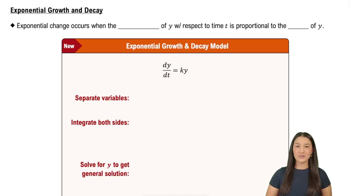
Exponential growth describes a process where a quantity increases at a rate proportional to its current value, often modeled by functions like y = y_0 * e^(kt). In this problem, the oil consumption rate increases by 1.5% per year, indicating exponential growth of the consumption rate over time.
Recommended video:
09:29
Exponential Growth & Decay

Integration of a Rate Function

To find the total amount consumed over time, you integrate the rate function with respect to time. Since the consumption rate changes exponentially, integrating this rate from the start year to a future time gives the cumulative oil consumed up to that point.
Recommended video:
04:16
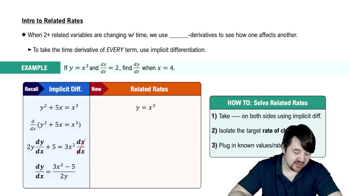
Intro To Related Rates

Solving Exponential Equations

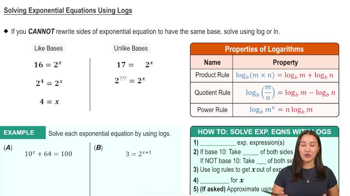
After integrating, you get an equation involving exponential terms to represent total consumption. Solving for time requires manipulating the equation, often using logarithms, to find when the cumulative consumption reaches a specified value, such as 10 million barrels.
Recommended video:
5:47
Solving Exponential Equations Using Logs
Related Practice
Textbook Question

Chemotherapy In an experimental study at Dartmouth College, mice with tumors were treated with the chemotherapeutic drug Cisplatin. Before treatment, the tumors consisted entirely of clonogenic cells that divide rapidly, causing the tumors to double in size every 2.9 days. Immediately after treatment, 99% of the cells in the tumor became quiescent cells which do not divide and lose 50% of their volume every 5.7 days. For a particular mouse, assume the tumor size is 0.5 cm³ at the time of treatment.

d. Plot a graph of V(t) for 0 ≤ t ≤ 15. What happens to the size of the tumor, assuming there are no follow-up treatments with Cisplatin?

40
views
Textbook Question

Properties of exp(x) Use the inverse relations between ln x and exp(x), and the properties of ln x, to prove the following properties:


c. (exp(x))ᵖ = exp(px), p rational

62
views
Textbook Question

Energy consumption On the first day of the year (t=0), a city uses electricity at a rate of 2000 MW. That rate is projected to increase at a rate of 1.3% per year.


c. Find a function that gives the total energy used (in MW-yr) between t=0 and any future time t>0.

35
views
Textbook Question

Velocity of falling body Refer to Exercise 95, which gives the position function for a falling body. Use m = 75 kg and k = 0.2.


c. How long does it take for the BASE jumper to reach a speed of 45 m/s (roughly 100 mi/hr)?

39
views
Textbook Question

ln x is unbounded Use the following argument to show that lim (x → ∞) ln x = ∞ and lim (x → 0⁺) ln x = −∞.

c. Show that ln 2ⁿ > n/2 and ln 2^(−n) < −n/2.

100
views
Textbook Question

Explain why or why not Determine whether the following statements are true and give an explanation or counterexample. Assume x > 0 and y > 0.


c. ln (x + y) = ln x + ln y

79
views