
Ch. 7 - Logarithmic, Exponential Functions, and Hyperbolic Functions
Briggs - Calculus: Early Transcendentals 3rd Edition
Briggs3rd EditionCalculus: Early TranscendentalsISBN: 9780136847243Not the one you use?Change textbook
Chapter 7, Problem 7.3.75a

Shallow-water velocity equation
a. Confirm that the linear approximation to ƒ(x) = tanh x at a = 0 is L(x) = x.

Verified step by step guidance
1
Recall that the linear approximation (or linearization) of a function \( f(x) \) at a point \( a \) is given by the formula: \[ L(x) = f(a) + f'(a)(x - a) \]
Identify the function and the point of approximation: here, \( f(x) = \tanh x \) and \( a = 0 \).
Calculate \( f(a) = \tanh 0 \). Since \( \tanh 0 = 0 \), this simplifies the linear approximation formula.
Find the derivative of \( f(x) = \tanh x \). Recall that \( \frac{d}{dx} \tanh x = \operatorname{sech}^2 x \).
Evaluate the derivative at \( a = 0 \): \( f'(0) = \operatorname{sech}^2 0 \). Since \( \operatorname{sech} 0 = 1 \), this gives \( f'(0) = 1 \). Substitute these values into the linear approximation formula to get \( L(x) = 0 + 1 \cdot (x - 0) = x \).

Verified video answer for a similar problem:

This video solution was recommended by our tutors as helpful for the problem above.
Video duration:
2m
Was this helpful?

Key Concepts

Here are the essential concepts you must grasp in order to answer the question correctly.

Linear Approximation (Linearization)

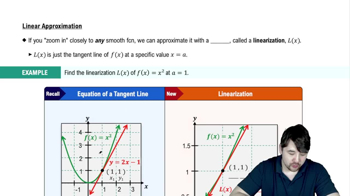
Linear approximation involves approximating a function near a point using the tangent line at that point. It is given by L(x) = f(a) + f'(a)(x - a), which simplifies calculations by replacing complex functions with linear ones close to a. This method is useful for estimating function values near the point a.
Recommended video:
07:17
Linearization

Derivative of tanh(x)

The derivative of tanh(x) is sech²(x), which measures the rate of change of tanh(x) at any point x. Evaluating this derivative at a specific point, such as x = 0, is essential for finding the slope of the tangent line used in linear approximation.
Recommended video:
04:56
Derivative of the Natural Exponential Function (e^x)

Properties of tanh(x) at x = 0

At x = 0, tanh(0) = 0, and its derivative f'(0) = sech²(0) = 1. These values simplify the linear approximation formula to L(x) = 0 + 1*(x - 0) = x, confirming that near zero, tanh(x) behaves approximately like the identity function.
Recommended video:
06:21
Properties of Functions