
Population of Texas Texas was the third fastest growing state in the United States in 2016. Texas grew from 25.1 million in 2010 to 26.47 million in 2016. Use an exponential growth model to predict the population of Texas in 2025.
Ch. 7 - Logarithmic, Exponential Functions, and Hyperbolic Functions
Briggs3rd EditionCalculus: Early TranscendentalsISBN: 9780136847243Not the one you use?Change textbook
All textbooks
Briggs 3rd Edition
Ch. 7 - Logarithmic, Exponential Functions, and Hyperbolic Functions
Problem 7.1.4
Briggs 3rd Edition
Ch. 7 - Logarithmic, Exponential Functions, and Hyperbolic Functions
Problem 7.1.4Chapter 7, Problem 7.1.4
What is the inverse function of ln x, and what are its domain and range?
Verified step by step guidance1
The inverse function of ln(x) is the exponential function, denoted as e^x. This is because the natural logarithm ln(x) and the exponential function e^x are inverse operations of each other.
To find the inverse function, start by setting y = ln(x). Then rewrite the equation in exponential form: x = e^y. This shows that the inverse function of ln(x) is f^(-1)(x) = e^x.
The domain of the natural logarithm function ln(x) is (0, ∞), meaning it is defined for all positive real numbers. Therefore, the range of its inverse function, e^x, is also (0, ∞).
The range of the natural logarithm function ln(x) is (-∞, ∞), meaning it can output any real number. Therefore, the domain of its inverse function, e^x, is also (-∞, ∞).
In summary, the inverse function of ln(x) is f^(-1)(x) = e^x, with a domain of (-∞, ∞) and a range of (0, ∞).

Verified video answer for a similar problem:
This video solution was recommended by our tutors as helpful for the problem above.
Video duration:
2mWas this helpful?
Key Concepts
Here are the essential concepts you must grasp in order to answer the question correctly.
Inverse Functions
An inverse function essentially reverses the effect of the original function. For a function f(x), its inverse f⁻¹(x) satisfies the condition f(f⁻¹(x)) = x for all x in the domain of f⁻¹. Understanding how to find the inverse involves swapping the roles of the input and output and solving for the new output.
Recommended video:
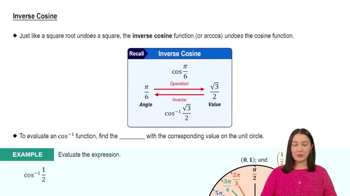
Inverse Cosine
Natural Logarithm (ln x)
The natural logarithm, denoted as ln x, is the logarithm to the base e, where e is approximately 2.718. It is defined for positive real numbers, and its output is the exponent to which e must be raised to obtain x. The function ln x is crucial in calculus for solving exponential equations and understanding growth processes.
Recommended video:
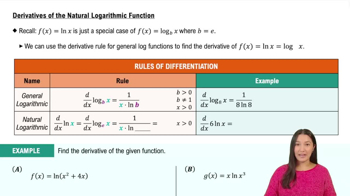
Derivative of the Natural Logarithmic Function
Domain and Range
The domain of a function is the set of all possible input values (x-values) for which the function is defined, while the range is the set of all possible output values (y-values). For the natural logarithm ln x, the domain is (0, ∞) since it is only defined for positive x, and the range is (-∞, ∞) because ln x can take any real number as its output.
Recommended video:
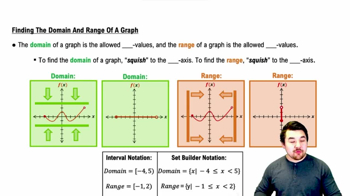
Finding the Domain and Range of a Graph
Related Practice
Textbook Question
53
views
Textbook Question
29–62. Integrals Evaluate the following integrals. Include absolute values only when needed.
∫₀ˡⁿ ² (e^{3x} − e^{−3x}) / (e^{3x} + e^{−3x}) dx
61
views
Textbook Question
Arc length Use the result of Exercise 108 to find the arc length of the curve: f(x) = ln |tanh(x / 2)| on [ln 2, ln 8].
44
views
Textbook Question
Express 3ˣ, x^{π}, and x^{sin x} using the base e.
60
views
Textbook Question
37–56. Integrals Evaluate each integral.
∫ sinh x / (1 + cosh x) dx
69
views
Textbook Question
13–14. Absolute and relative growth rates Two functions f and g are given. Show that the growth rate of the linear function is constant and the relative growth rate of the exponential function is constant.
f(t) = 100 + 10.5t, g(t) = 100e^(t/10)
71
views