Ch. 8 - Integration Techniques
Briggs - Calculus: Early Transcendentals 3rd Edition
Briggs3rd EditionCalculus: Early TranscendentalsISBN: 9780136847243Not the one you use?Change textbook
Chapter 8, Problem 8.5.2d

2. Give an example of each of the following.
d. A repeated irreducible quadratic factor

Verified step by step guidance
1
Understand what an irreducible quadratic factor is: it is a quadratic polynomial (degree 2) that cannot be factored further over the real numbers, meaning it has no real roots.
Recognize that a repeated irreducible quadratic factor means the quadratic factor appears more than once in the factorization of a polynomial.
Construct an example by choosing an irreducible quadratic, such as \(x^{2} + 1\), which has no real roots and cannot be factored over the reals.
Form a polynomial where this quadratic factor is repeated, for example, by squaring it: \((x^{2} + 1)^{2}\).
Write the full polynomial explicitly: \((x^{2} + 1)^{2} = (x^{2} + 1)(x^{2} + 1)\), which clearly shows the repeated irreducible quadratic factor.

Verified video answer for a similar problem:

This video solution was recommended by our tutors as helpful for the problem above.
Video duration:
4m
Was this helpful?

Key Concepts

Here are the essential concepts you must grasp in order to answer the question correctly.

Irreducible Quadratic Factor

An irreducible quadratic factor is a quadratic polynomial that cannot be factored into real linear factors. Typically, it has a negative discriminant (b² - 4ac < 0), meaning it has no real roots. For example, x² + 1 is irreducible over the real numbers.
Recommended video:
13:42
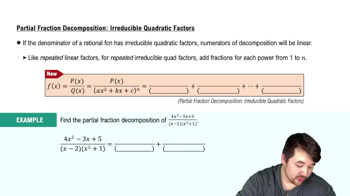
Partial Fraction Decomposition: Irreducible Quadratic Factors

Repeated Factor

A repeated factor in a polynomial is a factor that appears more than once, indicating multiplicity greater than one. For instance, (x - 2)² means the factor (x - 2) is repeated twice. Repeated factors affect the shape of the graph and the behavior of the function at the root.
Recommended video:
11:26
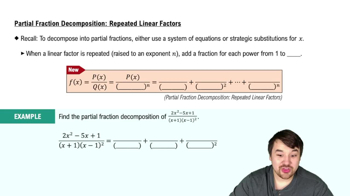
Partial Fraction Decomposition: Repeated Linear Factors

Combining Repeated and Irreducible Quadratic Factors

A repeated irreducible quadratic factor is a quadratic polynomial that is irreducible and appears with multiplicity greater than one in a polynomial. For example, (x² + 1)² is a repeated irreducible quadratic factor because x² + 1 cannot be factored further and is squared.
Recommended video:
13:42
Partial Fraction Decomposition: Irreducible Quadratic Factors
Related Practice
Textbook Question

81. Possible and impossible integrals

Let Iₙ = ∫ xⁿ e⁻ˣ² dx, where n is a nonnegative integer.

d. Show that, in general, if n is odd, then Iₙ = -½ e⁻ˣ² pₙ₋₁(x), where pₙ₋₁ is a polynomial of degree n - 1.

66
views

Textbook Question

57. Explain why or why not Determine whether the following statements are true and give an explanation or counterexample.

d. The integral ∫ dx/(x² + 4x + 9) cannot be evaluated using a trigonometric substitution.

43
views
Textbook Question

66–71. {Use of Tech} Estimating error Refer to Theorem 8.1 in the following exercises.

66. Let f(x) = cos(x²).

d. Use Theorem 8.1 to find an upper bound on the absolute error in the estimate found in part (a).

51
views
Textbook Question

66–71. {Use of Tech} Estimating error Refer to Theorem 8.1 in the following exercises.

67. Let f(x) = √(x³ + 1).

d. Use Theorem 8.1 to find an upper bound on the absolute error in the estimate found in part (a).

56
views
Textbook Question

93. Three start-ups Three cars, A, B, and C, start from rest and accelerate along a line according to the following velocity functions:

vₐ(t) = 88t/(t + 1), v_B(t) = 88t²/(t + 1)², and v_C(t) = 88t²/(t² + 1).

d. Which car ultimately gains the lead and remains in front?

42
views
Textbook Question

Explain why or why not Determine whether the following statements are true and give an explanation or counterexample.

d. Using the substitution u = tan(x) in ∫ (tan²x / (tan x - 1)) dx leads to ∫ (u² / (u - 1)) du.

41
views