Ch. 8 - Integration Techniques
Briggs - Calculus: Early Transcendentals 3rd Edition
Briggs3rd EditionCalculus: Early TranscendentalsISBN: 9780136847243Not the one you use?Change textbook
Chapter 8, Problem 8.5.32

23-64. Integration Evaluate the following integrals.
32. ∫ (4x - 2)/(x³ - x) dx

Verified step by step guidance
1
First, observe the integral \( \int \frac{4x - 2}{x^{3} - x} \, dx \). Notice that the denominator can be factored. Factor \( x^{3} - x \) as \( x(x^{2} - 1) \), which further factors to \( x(x - 1)(x + 1) \).
Rewrite the integral using partial fraction decomposition. Express \( \frac{4x - 2}{x(x - 1)(x + 1)} \) as \( \frac{A}{x} + \frac{B}{x - 1} + \frac{C}{x + 1} \), where \( A, B, C \) are constants to be determined.
Multiply both sides of the equation by the denominator \( x(x - 1)(x + 1) \) to clear the fractions, resulting in an equation involving \( A, B, C \) and powers of \( x \). Equate the coefficients of corresponding powers of \( x \) on both sides to form a system of linear equations.
Solve the system of equations to find the values of \( A, B, C \). Once these constants are found, rewrite the integral as the sum of simpler integrals: \( \int \frac{A}{x} \, dx + \int \frac{B}{x - 1} \, dx + \int \frac{C}{x + 1} \, dx \).
Integrate each term separately using the formula \( \int \frac{1}{x - a} \, dx = \ln|x - a| + C \). Combine the results and include the constant of integration \( C \) to write the final expression for the integral.

Verified video answer for a similar problem:

This video solution was recommended by our tutors as helpful for the problem above.
Video duration:
6m
Was this helpful?

Key Concepts

Here are the essential concepts you must grasp in order to answer the question correctly.

Partial Fraction Decomposition

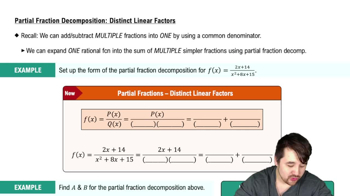
Partial fraction decomposition is a technique used to break down a complex rational function into simpler fractions that are easier to integrate. It involves expressing the integrand as a sum of fractions with simpler denominators, typically linear or quadratic factors. This method is essential when integrating rational functions where the degree of the numerator is less than the degree of the denominator.
Recommended video:
10:07
Partial Fraction Decomposition: Distinct Linear Factors

Integration of Rational Functions

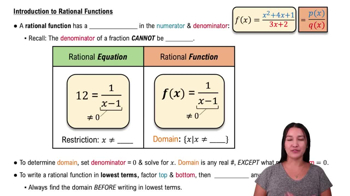
Integrating rational functions often requires rewriting the integrand into a form suitable for direct integration, such as sums of simpler fractions. After decomposition, each term can be integrated using basic integral formulas, including logarithmic and inverse trigonometric functions. Understanding how to handle these integrals is key to solving problems involving rational expressions.
Recommended video:
6:04
Intro to Rational Functions

Factoring Polynomials

Factoring polynomials is the process of expressing a polynomial as a product of its factors, which simplifies the integrand and aids in partial fraction decomposition. Recognizing common factors or special products (like difference of squares) helps break down the denominator into linear or quadratic factors. This step is crucial for setting up the integral correctly.
Recommended video:
07:00
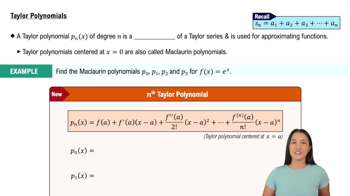
Taylor Polynomials
Related Practice
Textbook Question

9–61. Trigonometric integrals Evaluate the following integrals.

47. ∫ (csc⁴x)/(cot²x) dx

96
views

Textbook Question

9–40. Integration by parts Evaluate the following integrals using integration by parts.

17. ∫ x · 3x dx

56
views
Textbook Question

102–106. Laplace transforms A powerful tool in solving problems in engineering and physics is the Laplace transform. Given a function f(t), the Laplace transform is a new function F(s) defined by F(s) = ∫[0 to ∞] e^(-st) f(t) dt, where we assume s is a positive real number. For example, to find the Laplace transform of f(t) = e^(-t), the following improper integral is evaluated using integration by parts:

F(s) = ∫[0 to ∞] e^(-st) e^(-t) dt = ∫[0 to ∞] e^(-(s+1)t) dt = 1/(s+1).

Verify the following Laplace transforms, where a is a real number.

104. f(t) = t → F(s) = 1/s²

99
views
Textbook Question

7–40. Table look-up integrals Use a table of integrals to evaluate the following indefinite integrals. Some of the integrals require preliminary work, such as completing the square or changing variables, before they can be found in a table.

28. ∫ ln² x dx

76
views
Textbook Question

54-57. Applying Reduction Formulas Use the reduction formulas from Exercises 50-53 to evaluate the following integrals:

55. ∫ x² cos(5x) dx

70
views
Textbook Question

Choosing an integration strategy Identify a technique of integration for evaluating the following integrals. If necessary, explain how to first simplify the integrand before applying the suggested technique of integration. You do not need to evaluate the integrals.

∫ (1 + tan x) sec²x dx

72
views