
Ch. 8 - Integration Techniques
Briggs - Calculus: Early Transcendentals 3rd Edition
Briggs3rd EditionCalculus: Early TranscendentalsISBN: 9780136847243Not the one you use?Change textbook
Chapter 8, Problem 8.R.63

2–74. Integration techniques Use the methods introduced in Sections 8.1 through 8.5 to evaluate the following integrals.
63. ∫ dx/(x² - 2x - 15)

Verified step by step guidance
1
Start by recognizing that the integral involves a rational function with a quadratic denominator: \(\int \frac{dx}{x^{2} - 2x - 15}\). The first step is to factor the quadratic expression in the denominator.
Factor the quadratic \(x^{2} - 2x - 15\) by finding two numbers that multiply to \(-15\) and add to \(-2\). This gives \(x^{2} - 2x - 15 = (x - 5)(x + 3)\).
Rewrite the integral using the factored form: \(\int \frac{dx}{(x - 5)(x + 3)}\). This sets up the integral for partial fraction decomposition.
Set up the partial fraction decomposition: \(\frac{1}{(x - 5)(x + 3)} = \frac{A}{x - 5} + \frac{B}{x + 3}\), where \(A\) and \(B\) are constants to be determined.
Multiply both sides by \((x - 5)(x + 3)\) to clear denominators, resulting in \(1 = A(x + 3) + B(x - 5)\). Then, solve for \(A\) and \(B\) by substituting convenient values for \(x\) or by equating coefficients.

Verified video answer for a similar problem:

This video solution was recommended by our tutors as helpful for the problem above.
Video duration:
3m
Was this helpful?

Key Concepts

Here are the essential concepts you must grasp in order to answer the question correctly.

Partial Fraction Decomposition

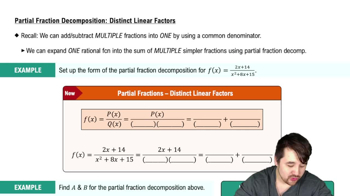
Partial fraction decomposition is a technique used to break down a rational function into simpler fractions that are easier to integrate. It is especially useful when the denominator can be factored into linear or quadratic terms. For example, expressing 1/(x² - 2x - 15) as a sum of fractions with denominators (x - 5) and (x + 3) simplifies integration.
Recommended video:
10:07
Partial Fraction Decomposition: Distinct Linear Factors

Factoring Quadratic Expressions

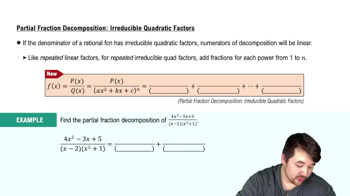
Factoring involves rewriting a quadratic expression as a product of two binomials. For the integral ∫ dx/(x² - 2x - 15), factoring the denominator into (x - 5)(x + 3) is essential to apply partial fractions. Recognizing how to factor quadratics quickly aids in simplifying integrals.
Recommended video:
13:42
Partial Fraction Decomposition: Irreducible Quadratic Factors

Integration of Rational Functions

Integrating rational functions often requires rewriting the integrand into simpler parts, such as partial fractions. Once decomposed, each term can be integrated using basic formulas, like ∫ dx/(x - a) = ln|x - a| + C. Understanding these standard integrals helps solve complex rational integrals efficiently.
Recommended video:
6:04
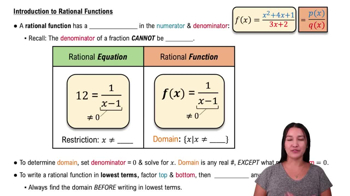
Intro to Rational Functions
Related Practice
Textbook Question

122. Comparing areas The region R₁ is bounded by the graph of y = tan(x) and the x-axis on the interval [0, π/3].

The region R₂ is bounded by the graph of y = sec(x) and the x-axis on the interval [0, π/6]. Which region has the greater area?

58
views
Textbook Question

2–74. Integration techniques Use the methods introduced in Sections 8.1 through 8.5 to evaluate the following integrals.

22. ∫ tan³ 5θ dθ

79
views
Textbook Question

2–74. Integration techniques Use the methods introduced in Sections 8.1 through 8.5 to evaluate the following integrals.

6. ∫ (2 − sin 2θ)/cos² 2θ dθ

72
views
Textbook Question

118. Two worthy integrals

b. Let f be any positive continuous function on the interval [0, π/2]. Evaluate

∫ from 0 to π/2 of [f(cos x) / (f(cos x) + f(sin x))] dx.

(Hint: Use the identity cos(π/2 − x) = sin x.)


(Source: Mathematics Magazine 81, 2, Apr 2008)

125
views
Textbook Question

120. Equal volumes

a. Let R be the region bounded by the graph of f(x) = x^(-p) and the x-axis, for x ≥ 1. Let V₁ and V₂ be the volumes of the solids generated when R is revolved about the x-axis and the y-axis, respectively, if they exist. For what values of p (if any) is V₁ = V₂?

b. Repeat part (a) on the interval [0, 1].

75
views
Textbook Question

119. {Use of Tech} Comparing volumes Let R be the region bounded by y = ln(x), the x-axis, and the line x = a, where a > 1.

b. Find the volume V₂(a) of the solid generated when R is revolved about the y-axis (as a function of a).

35
views