Ch. 8 - Integration Techniques
Briggs - Calculus: Early Transcendentals 3rd Edition
Briggs3rd EditionCalculus: Early TranscendentalsISBN: 9780136847243Not the one you use?Change textbook
Chapter 8, Problem 8.8.38

37-40. {Use of Tech} Temperature data
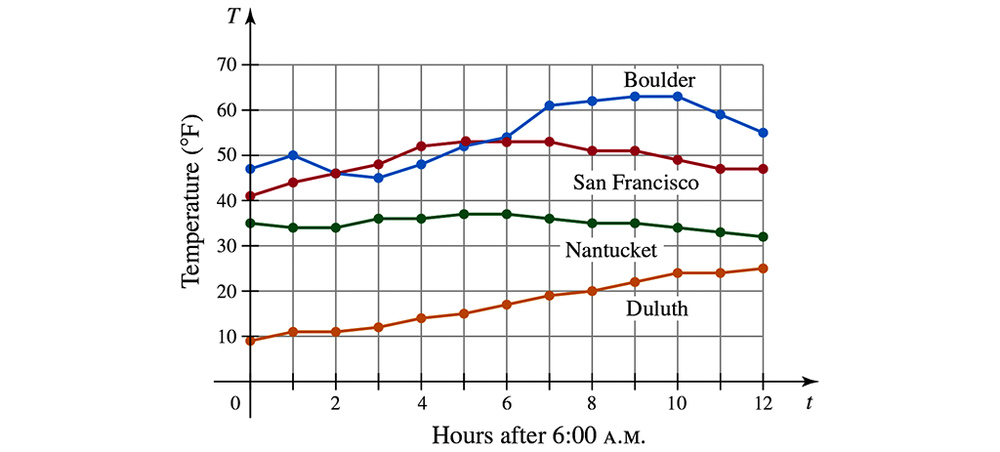
Howdy temperature data for Boulder, Colorado; San Francisco, California; Nantucket, Massachusetts; and Duluth, Minnesota, over a 12-hr period on the same day of January are shown in the figure.
Line graph showing temperature changes over 12 hours for Boulder, San Francisco, Nantucket, and Duluth.
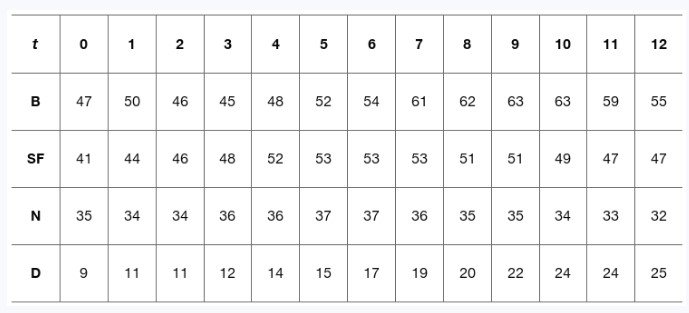
Table showing hourly temperature data in °F over 12 hours for Boulder, San Francisco, Nantucket, and Duluth.
Assume these data are taken from a continuous temperature function T(t). The average temperature (in °F) over the 12-hr period is:
T_avg = (1/12) × ∫(0 to 12) T(t) dt
38. Find an accurate approximation to the average temperature over the 12-hr period for San Francisco. State your method.

Verified step by step guidance
1
Identify the temperature data for San Francisco (SF) from the table, which gives temperature values at each hour from 0 to 12.
Recall the formula for the average temperature over the 12-hour period: \(T_{avg} = \frac{1}{12} \int_0^{12} T(t) \, dt\).
Since the temperature data is discrete, approximate the integral \(\int_0^{12} T(t) \, dt\) using a numerical integration method such as the Trapezoidal Rule or Simpson's Rule.
For the Trapezoidal Rule, calculate the sum: \(\frac{\Delta t}{2} \left[ T(0) + 2T(1) + 2T(2) + \cdots + 2T(11) + T(12) \right]\), where \(\Delta t = 1\) hour.
Finally, multiply the result of the numerical integration by \(\frac{1}{12}\) to find the average temperature \(T_{avg}\) over the 12-hour period.

Verified video answer for a similar problem:

This video solution was recommended by our tutors as helpful for the problem above.
Video duration:
3m
Was this helpful?

Key Concepts

Here are the essential concepts you must grasp in order to answer the question correctly.

Definite Integral as Area Under a Curve

The definite integral of a function over an interval represents the net area under the curve between the interval's endpoints. In this context, integrating the temperature function T(t) from 0 to 12 hours gives the total accumulated temperature over that period, which is essential for calculating the average temperature.
Recommended video:
05:43
Definition of the Definite Integral

Average Value of a Function

The average value of a continuous function over an interval [a, b] is given by (1/(b - a)) times the definite integral of the function over that interval. Here, the average temperature over 12 hours is found by dividing the integral of T(t) from 0 to 12 by 12, providing a meaningful summary of temperature changes.
Recommended video:
06:37
Average Value of a Function

Numerical Integration Methods (e.g., Trapezoidal Rule)

When the exact integral of a function is difficult to find, numerical methods like the trapezoidal rule approximate the integral using discrete data points. By summing trapezoids formed between temperature readings at hourly intervals, one can estimate the integral of T(t) and thus approximate the average temperature accurately.
Recommended video:
05:56
Additional Rules for Indefinite Integrals