Ch. 8 - Integration Techniques
Briggs - Calculus: Early Transcendentals 3rd Edition
Briggs3rd EditionCalculus: Early TranscendentalsISBN: 9780136847243Not the one you use?Change textbook
Chapter 8, Problem 8.8.46c

45–48. {Use of Tech} Trapezoid Rule and Simpson’s Rule Consider the following integrals and the given values of n.
46. ∫(0 to 2) x⁴ dx; n = 30
c. Compute the absolute errors in the Trapezoid Rule and Simpson’s Rule with 2n subintervals.

Verified step by step guidance
1
Step 1: Understand the problem. You are tasked with calculating the absolute errors in the Trapezoid Rule and Simpson’s Rule for the integral ∫(0 to 2) x⁴ dx using 2n subintervals, where n = 30. This means you will use 60 subintervals for both methods.
Step 2: Recall the formulas for the Trapezoid Rule and Simpson’s Rule. The Trapezoid Rule approximates the integral as a sum of trapezoidal areas, while Simpson’s Rule uses parabolic segments for approximation. Both methods depend on the number of subintervals and the function being integrated.
Step 3: Compute the exact value of the integral ∫(0 to 2) x⁴ dx. To do this, use the power rule for integration: ∫x⁴ dx = (x⁵)/5 + C. Evaluate this definite integral from 0 to 2 to find the exact value. This will be used to calculate the absolute errors later.
Step 4: Apply the Trapezoid Rule and Simpson’s Rule with 60 subintervals. For the Trapezoid Rule, divide the interval [0, 2] into 60 equal parts, calculate the function values at each endpoint, and use the formula for the Trapezoid Rule. For Simpson’s Rule, divide the interval into 60 subintervals, calculate the function values at endpoints and midpoints, and apply Simpson’s Rule formula.
Step 5: Calculate the absolute errors. The absolute error for each method is the absolute difference between the exact value of the integral and the approximate value obtained using the respective rule. Use the exact value from Step 3 and the approximations from Step 4 to compute these errors.

Verified video answer for a similar problem:

This video solution was recommended by our tutors as helpful for the problem above.
Video duration:
4m
Was this helpful?

Key Concepts

Here are the essential concepts you must grasp in order to answer the question correctly.

Trapezoid Rule

The Trapezoid Rule is a numerical method for approximating the definite integral of a function. It works by dividing the area under the curve into trapezoids rather than rectangles, which provides a better approximation. The formula involves calculating the average of the function values at the endpoints of each subinterval and multiplying by the width of the subintervals. This method is particularly useful when an analytical solution is difficult to obtain.
Recommended video:

Simpson’s Rule

Simpson’s Rule is another numerical technique for estimating the value of a definite integral. It approximates the integrand by a quadratic polynomial, using parabolic segments instead of straight lines. The rule requires an even number of subintervals and combines the function values at the endpoints and midpoints of the intervals. This method generally provides a more accurate approximation than the Trapezoid Rule, especially for smooth functions.
Recommended video:

Absolute Error

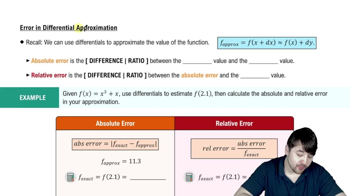
Absolute error measures the difference between the exact value of an integral and the approximate value obtained using numerical methods like the Trapezoid Rule or Simpson’s Rule. It is calculated as the absolute value of the difference between these two values. Understanding absolute error is crucial for assessing the accuracy of numerical approximations and helps in determining how close the approximation is to the true value.
Recommended video:
04:57
Determining Error and Relative Error