Ch. 8 - Integration Techniques
Briggs - Calculus: Early Transcendentals 3rd Edition
Briggs3rd EditionCalculus: Early TranscendentalsISBN: 9780136847243Not the one you use?Change textbook
Chapter 8, Problem 8.8.66b

66–71. {Use of Tech} Estimating error Refer to Theorem 8.1 in the following exercises.
66. Let f(x) = cos(x²).
b. Calculate f''(x).

Verified step by step guidance
1
Recall that the function is given by \(f(x) = \cos(x^2)\). Our goal is to find the second derivative \(f''(x)\).
First, find the first derivative \(f'(x)\) by applying the chain rule. The derivative of \(\cos(u)\) with respect to \(u\) is \(-\sin(u)\), and here \(u = x^2\). So, \(f'(x) = -\sin(x^2) \cdot \frac{d}{dx}(x^2)\).
Calculate the derivative of the inner function: \(\frac{d}{dx}(x^2) = 2x\). Substitute this back to get \(f'(x) = -2x \sin(x^2)\).
Next, find the second derivative \(f''(x)\) by differentiating \(f'(x) = -2x \sin(x^2)\). Use the product rule: if \(h(x) = u(x)v(x)\), then \(h'(x) = u'(x)v(x) + u(x)v'(x)\).
Let \(u(x) = -2x\) and \(v(x) = \sin(x^2)\). Then, \(u'(x) = -2\) and \(v'(x)\) requires the chain rule again: \(v'(x) = \cos(x^2) \cdot 2x\). Substitute these into the product rule formula to express \(f''(x)\).

Verified video answer for a similar problem:

This video solution was recommended by our tutors as helpful for the problem above.
Video duration:
2m
Was this helpful?

Key Concepts

Here are the essential concepts you must grasp in order to answer the question correctly.

Second Derivative

The second derivative of a function measures the rate of change of the first derivative, providing information about the function's concavity and acceleration. It is found by differentiating the first derivative once more with respect to the variable.
Recommended video:
06:02
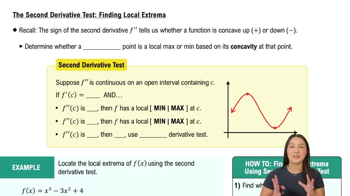
The Second Derivative Test: Finding Local Extrema

Chain Rule

The chain rule is a differentiation technique used when dealing with composite functions. It states that the derivative of f(g(x)) is f'(g(x)) multiplied by g'(x), allowing us to differentiate functions like cos(x²) effectively.
Recommended video:
05:02
Intro to the Chain Rule

Derivative of Trigonometric Functions

Understanding the derivatives of basic trigonometric functions, such as d/dx[cos(x)] = -sin(x), is essential. This knowledge helps in differentiating more complex functions involving trigonometric expressions.
Recommended video:
06:35
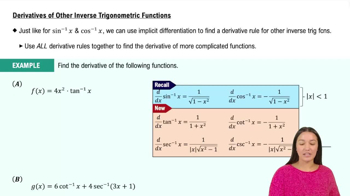
Derivatives of Other Inverse Trigonometric Functions
Related Practice
Textbook Question

71. Different Methods

Let I = ∫ (x²)/(x + 1) dx.

b. Evaluate I by first performing long division on the integrand.

69
views

Textbook Question

Practice with tabular integration Evaluate the following integrals using tabular integration (refer to Exercise 77).

b. ∫ 7x e³ˣ dx

163
views
Textbook Question

The Eiffel Tower Property Let R be the region between the curves y = e^(-c·x) and y = -e^(-c·x) on the interval [a, ∞), where a ≥ 0 and c > 0.

The center of mass of R is located at (x̄, 0), where x̄ = [∫(a to ∞) x·e^(-c·x) dx] / [∫(a to ∞) e^(-c·x) dx]

(The profile of the Eiffel Tower is modeled by these two exponential curves; see the Guided Project ""The exponential Eiffel Tower"")

b. With a = 0 and c = 2, find the equations of the lines tangent to both curves at x = 0

58
views
Textbook Question

{Use of Tech} Powers of sine and cosine It can be shown that

∫ from 0 to π/2 of sinⁿx dx = ∫ from 0 to π/2 of cosⁿx dx =

{

[1·3·5···(n-1)]/[2·4·6···n] · π/2 if n ≥ 2 is even

[2·4·6···(n-1)]/[3·5···n] if n ≥ 3 is odd

}

b. Evaluate the integrals with n = 10 and confirm the result.

99
views
Textbook Question

93. Three start-ups Three cars, A, B, and C, start from rest and accelerate along a line according to the following velocity functions:

vₐ(t) = 88t/(t + 1), v_B(t) = 88t²/(t + 1)², and v_C(t) = 88t²/(t² + 1).

b. Which car travels farthest on the interval 0 ≤ t ≤ 5?

47
views
Textbook Question

Area and volume Consider the function f(x) = (9 + x²)^(-1/2) and the region R on the interval [0, 4] (see figure).


b. Find the volume of the solid generated when R is revolved about the x-axis.


62
views