108. Draining a tank Water is drained from a 3000-gal tank at a rate that starts at 100 gal/hr and decreases continuously by 5%/hr. If the drain is left open indefinitely, how much water drains from the tank? Can a full tank be emptied at this rate?
7–58. Improper integrals Evaluate the following integrals or state that they diverge.
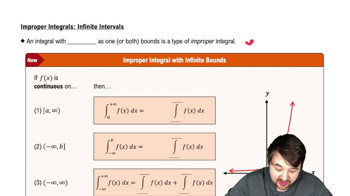
42. ∫ (from 3 to 4) 1/(x-3)³ᐟ² dx
Verified step by step guidance
Verified video answer for a similar problem:
Key Concepts
Improper Integrals
Behavior of Functions Near Singularities
Evaluating Limits for Convergence
Visual proof Let F(x)=∫₀ˣ √(a²−t²) dt. The figure shows that F(x)= area of sector OAB+ area of triangle OBC.
a. Use the figure to prove that
F(x) = (a² sin ⁻¹(x/a))/2 + x√(a²−x²)/2
b. Conclude that ∫ √(a²−x²) dx = (a² sin ⁻¹(x/a))/2 + x√(a²−x²)/2 + C.
{Use of Tech} Using the integral of sec³u By reduction formula 4 in Section 8.3,
∫sec³u du = 1/2 (sec u tan u + ln |sec u + tan u|) + C
Graph the following functions and find the area under the curve on the given interval.
f(x) = (9 - x²) ⁻², [0, 3/2]
102–106. Laplace transforms A powerful tool in solving problems in engineering and physics is the Laplace transform. Given a function f(t), the Laplace transform is a new function F(s) defined by F(s) = ∫[0 to ∞] e^(-st) f(t) dt, where we assume s is a positive real number. For example, to find the Laplace transform of f(t) = e^(-t), the following improper integral is evaluated using integration by parts:
F(s) = ∫[0 to ∞] e^(-st) e^(-t) dt = ∫[0 to ∞] e^(-(s+1)t) dt = 1/(s+1).
Verify the following Laplace transforms, where a is a real number.
106. f(t) = cos(at) → F(s) = s/(s² + a²)

87-92. An integrand with trigonometric functions in the numerator and denominator can often be converted to a rational function using the substitution u = tan(x/2) or, equivalently, x = 2 tan⁻¹u. The following relations are used in making this change of variables.
A: dx = 2/(1 + u²) du
B: sin x = 2u/(1 + u²)
C: cos x = (1 - u²)/(1 + u²)
88. Evaluate ∫ dx/(2 + cos x).
7–84. Evaluate the following integrals.
62. ∫ from 0 to π/2 √(1 + cosθ) dθ