
Ch. 8 - Integration Techniques
Briggs - Calculus: Early Transcendentals 3rd Edition
Briggs3rd EditionCalculus: Early TranscendentalsISBN: 9780136847243Not the one you use?Change textbook
Chapter 8, Problem 8.9.112c

Gaussians An important function in statistics is the Gaussian (or normal distribution, or bell-shaped curve), f(x) = e^(-ax²).
c. Complete the square to evaluate ∫ from -∞ to ∞ of e^(-(ax² + bx + c)) dx, where a > 0, b, and c are real numbers.

Verified step by step guidance
1
Start with the integral \( \int_{-\infty}^{\infty} e^{-(ax^2 + bx + c)} \, dx \), where \(a > 0\), and \(b, c\) are real numbers.
To simplify the exponent, complete the square for the quadratic expression \(ax^2 + bx + c\). Factor out \(a\) from the terms involving \(x\): \(ax^2 + bx + c = a\left(x^2 + \frac{b}{a}x\right) + c\).
Next, complete the square inside the parentheses: \(x^2 + \frac{b}{a}x = \left(x + \frac{b}{2a}\right)^2 - \left(\frac{b}{2a}\right)^2\). Substitute this back to get \(ax^2 + bx + c = a\left(x + \frac{b}{2a}\right)^2 - a\left(\frac{b}{2a}\right)^2 + c\).
Rewrite the integral using the completed square form: \(\int_{-\infty}^{\infty} e^{-\left[a\left(x + \frac{b}{2a}\right)^2 - a\left(\frac{b}{2a}\right)^2 + c\right]} \, dx = \int_{-\infty}^{\infty} e^{-a\left(x + \frac{b}{2a}\right)^2} e^{a\left(\frac{b}{2a}\right)^2 - c} \, dx\).
Since \(e^{a\left(\frac{b}{2a}\right)^2 - c}\) is a constant with respect to \(x\), factor it out of the integral. Then, perform the substitution \(u = x + \frac{b}{2a}\), which does not change the limits of integration because they are infinite. The integral reduces to \(e^{a\left(\frac{b}{2a}\right)^2 - c} \int_{-\infty}^{\infty} e^{-a u^2} \, du\), which is a standard Gaussian integral.

Verified video answer for a similar problem:

This video solution was recommended by our tutors as helpful for the problem above.
Video duration:
6m
Was this helpful?

Key Concepts

Here are the essential concepts you must grasp in order to answer the question correctly.

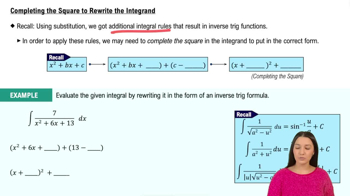
Completing the Square

Completing the square is a technique used to rewrite a quadratic expression in the form ax² + bx + c as a perfect square plus a constant. This simplifies integration and other operations by transforming the expression into a form like a(x + d)² + e, making it easier to handle exponential functions involving quadratics.
Recommended video:
05:22
Completing the Square to Rewrite the Integrand

Gaussian Integral

The Gaussian integral refers to the integral of the function e^(-ax²) over the entire real line, which evaluates to √(π/a) for a > 0. This result is fundamental in probability and statistics, especially for normal distributions, and serves as a basis for evaluating more complex integrals involving quadratic exponents.
Recommended video:
06:18
Integration by Parts for Definite Integrals

Properties of Exponential Functions

Exponential functions with quadratic exponents, such as e^(-(ax² + bx + c)), can be manipulated using algebraic techniques like completing the square. Understanding how to factor and rewrite these functions is essential for integrating them, as it allows the integral to be expressed in terms of known Gaussian integrals.
Recommended video:
06:21
Properties of Functions