Ch. 8 - Integration Techniques
Briggs - Calculus: Early Transcendentals 3rd Edition
Briggs3rd EditionCalculus: Early TranscendentalsISBN: 9780136847243Not the one you use?Change textbook
Chapter 8, Problem 8.9.100d

The Eiffel Tower Property Let R be the region between the curves y = e^(-c·x) and y = -e^(-c·x) on the interval [a, ∞), where a ≥ 0 and c > 0.
The center of mass of R is located at (x̄, 0), where x̄ = [∫(a to ∞) x·e^(-c·x) dx] / [∫(a to ∞) e^(-c·x) dx]
(The profile of the Eiffel Tower is modeled by these two exponential curves; see the Guided Project "The exponential Eiffel Tower")
d. Prove this property holds for any a ≥ 0 and c > 0:
The tangent lines to y = ±e^(-c·x) at x = a always intersect at R's center of mass
(Source: P. Weidman and I. Pinelis, Comptes Rendu, Mechanique, 332, 571-584, 2004)

Verified step by step guidance
1
First, write down the equations of the tangent lines to the curves \(y = e^{-c\cdot x}\) and \(y = -e^{-c\cdot x}\) at the point \(x = a\). To do this, find the derivatives of both functions at \(x = a\):
Calculate the derivative of \(y = e^{-c\cdot x}\), which is \(y' = -c e^{-c\cdot x}\). Evaluate this at \(x = a\) to get the slope of the tangent line: \(m = -c e^{-c a}\). Similarly, the derivative of \(y = -e^{-c\cdot x}\) is \(y' = c e^{-c\cdot x}\), and at \(x = a\) the slope is \(m = c e^{-c a}\).
Write the equations of the tangent lines using point-slope form. For the upper curve, the tangent line at \((a, e^{-c a})\) is: \[ y = e^{-c a} + (-c e^{-c a})(x - a) = e^{-c a} - c e^{-c a} (x - a) \] For the lower curve, the tangent line at \((a, -e^{-c a})\) is: \[ y = -e^{-c a} + (c e^{-c a})(x - a) = -e^{-c a} + c e^{-c a} (x - a) \]
Find the intersection point \((x_I, y_I)\) of these two tangent lines by setting their \(y\) values equal: \[ e^{-c a} - c e^{-c a} (x_I - a) = -e^{-c a} + c e^{-c a} (x_I - a) \] Simplify this equation to solve for \(x_I\).
After solving for \(x_I\), observe that the \(y\)-coordinate of the intersection \(y_I\) is zero due to symmetry. Then, compare \(x_I\) with the expression for the center of mass \(\bar{x} = \frac{\int_a^{\infty} x e^{-c x} dx}{\int_a^{\infty} e^{-c x} dx}\). Show that \(x_I = \bar{x}\), thus proving that the tangent lines intersect at the center of mass for any \(a \geq 0\) and \(c > 0\).

Verified video answer for a similar problem:

This video solution was recommended by our tutors as helpful for the problem above.
Video duration:
6m
Was this helpful?

Key Concepts

Here are the essential concepts you must grasp in order to answer the question correctly.

Center of Mass for a Planar Region

The center of mass (centroid) of a planar region is the average position of all points in the region, weighted by area. For regions bounded by curves, it is found using integrals of the form x̄ = (∫ x·f(x) dx) / (∫ f(x) dx), where f(x) represents the vertical distance between curves. This concept helps locate the balance point of the region.
Recommended video:
07:45
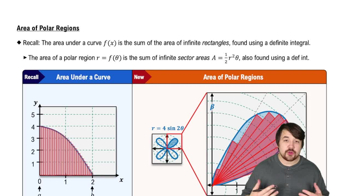
Area of Polar Regions

Tangent Lines to Exponential Curves

A tangent line to a curve at a point touches the curve without crossing it and has a slope equal to the derivative at that point. For y = ±e^(-c·x), the derivative is ±(-c)e^(-c·x). Understanding these tangent lines at x = a is essential to analyze their intersection and relate it to the center of mass.
Recommended video:
05:13
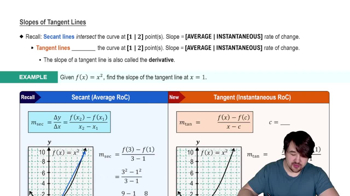
Slopes of Tangent Lines

Improper Integrals and Convergence on [a, ∞)

Integrals over infinite intervals, like ∫_a^∞ e^(-c·x) dx, are improper integrals that converge if the integrand decays sufficiently fast. Here, the exponential decay ensures convergence for c > 0. Evaluating these integrals is crucial to compute the center of mass and prove properties involving infinite domains.
Recommended video:
11:11
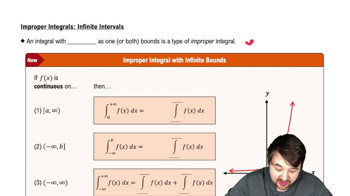
Improper Integrals: Infinite Intervals