Back
Back
Problem 8.2.77d
77. Tabular integration Consider the integral ∫ f(x)g(x) dx, where f can be differentiated repeatedly and g can be integrated repeatedly
Let Gₖ represent the result of calculating k indefinite integrals of g (omitting constants of integration).
d. The tabular integration table from part (c) is easily extended to allow for as many steps as necessary in the process of integration by parts.
Evaluate ∫ x² e^(x/2) dx by constructing an appropriate table, and explain why the process terminates after four rows of the table have been filled in.
Problem 8.2.82e
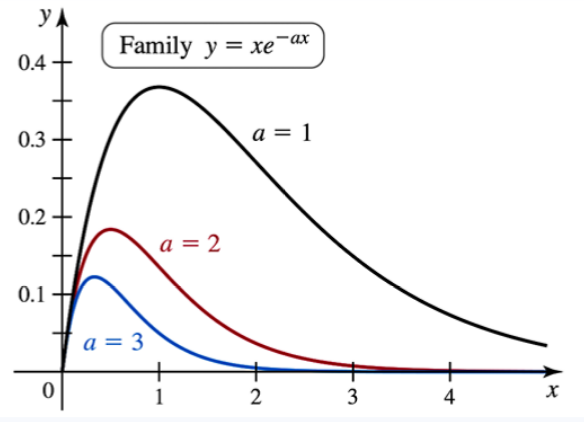
82. A family of exponentials The curves y = x * e^(-a * x) are shown in the figure for a = 1, 2, and 3.
e. Does this pattern continue? Is it true that A(1, ln b) = a² * A(a, (ln b)/a)?
Problem 8.3.75e
75. Exploring powers of sine and cosine
e. Repeat parts (a), (b), and (c) with sin²x replaced by sin⁴x. Comment on your observations.
Problem 8.2.78e
78. Practice with tabular integration Evaluate the following integrals using tabular integration (refer to Exercise 77).
e. ∫ (2x² - 3x) / (x - 1)³ dx