 Back
Back
Problem 8.6.85a
85. Explain why or why not Determine whether the following statements are true and give an explanation or counterexample.
a. More than one integration method can be used to evaluate ∫ (1 / (1 - x²)) dx.
Problem 8.3.63a
63. Explain why or why not Determine whether the following statements are true and give an explanation or counterexample.
a. If m is a positive integer, then ∫[0 to π] cos^(2m+1)(x) dx = 0.
Problem 8.4.78a
Computing areas On the interval [0,2], the graphs of f(x)=x²/3 and g(x)=x²(9−x²)^(-1/2) have similar shapes.
a. Find the area of the region bounded by the graph of f and the x-axis on the interval [0,2].
Problem 8.5.65a
65. Explain why or why not Determine whether the following statements are true and give an explanation or counterexample.
a. To evaluate ∫ (4x⁶)/(x⁴ + 3x²) dx, the first step is to find the partial fraction decomposition of the integrand.
Problem 8.8.66a
66–71. {Use of Tech} Estimating error Refer to Theorem 8.1 in the following exercises.
66. Let f(x) = cos(x²).
a. Find a Midpoint Rule approximation to ∫[-1 to 1] cos(x²) dx using n = 30 subintervals.
Problem 8.2.75a
75. {Use of Tech} Oscillator displacements Suppose a mass on a spring that is slowed by friction has the position function:
s(t) = e⁻ᵗ sin t
a. Graph the position function. At what times does the oscillator pass through the position s = 0?
Problem 8.9.62a
62. Electronic Chips Suppose the probability that a particular computer chip fails after a hours of operation is 0.00005 ∫(from a to ∞) e^(-0.00005t) dt.
a. Find the probability that the computer chip fails after 15,000 hr of operation.
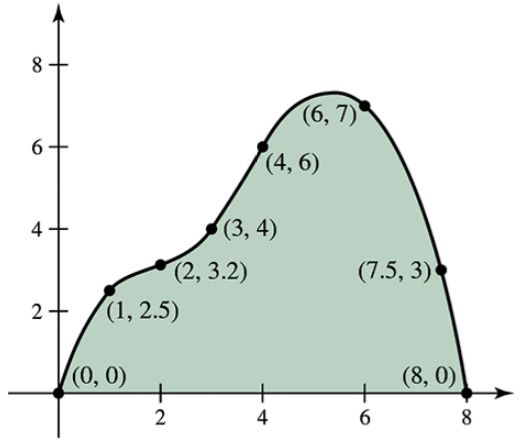
Problem 8.8.44a
A piece of wood paneling must be cut in the shape shown in the figure.
The coordinates of several points on its curved surface are also shown (with units of inches).
a. Estimate the surface area of the paneling using the Trapezoid Rule.
Problem 8.8.71a
66–71. {Use of Tech} Estimating error Refer to Theorem 8.1 in the following exercises.
71. Let f(x) = √(sin x).
a. Find a Simpson's Rule approximation to the integral from 1 to 2 of √(sin x) dx using n = 20 subintervals.
Problem 8.1.65a
Explain why or why not Determine whether the following statements are true and give an explanation or counterexample.
a. ∫(3/(x² + 4)) dx = ∫(3/x²) dx + ∫(3/4) dx.
Problem 8.5.93b
93. Three start-ups Three cars, A, B, and C, start from rest and accelerate along a line according to the following velocity functions:
vₐ(t) = 88t/(t + 1), v_B(t) = 88t²/(t + 1)², and v_C(t) = 88t²/(t² + 1).
b. Which car travels farthest on the interval 0 ≤ t ≤ 5?
Problem 8.2.78b
Practice with tabular integration Evaluate the following integrals using tabular integration (refer to Exercise 77).
b. ∫ 7x e³ˣ dx
Problem 8.2.58b
58. Two Methods Evaluate ∫(from 0 to π/3) sin(x) · ln(cos(x)) dx in the following two ways:
b. Use substitution.
Problem 8.9.111b
Gamma function The gamma function is defined by Γ(p) = ∫ from 0 to ∞ of x^(p-1) e^(-x) dx, for p not equal to zero or a negative integer.
b. Use the substitution x = u² and the fact that ∫ from 0 to ∞ of e^(-u²) du = √(π/2) to show that Γ(1/2) = √π.
Problem 8.8.67b
66–71. {Use of Tech} Estimating error Refer to Theorem 8.1 in the following exercises.
67. Let f(x) = √(x³ + 1).
b. Calculate f''(x).
Problem 8.2.59b
59. Two Methods
b. Evaluate ∫(x / √(x + 1)) dx using substitution.
Problem 8.9.88b
88. Incorrect Calculation
b. Evaluate ∫(from -1 to 1) dx/x or show that the integral does not exist.
Problem 8.2.82b
82. A family of exponentials The curves y = x * e^(-a * x) are shown in the figure for a = 1, 2, and 3.
b. Find the area of the region bounded by y = x * e^(-a * x) and the x-axis on the interval [0, 4], where a > 0.
Problem 8.8.71b
66–71. {Use of Tech} Estimating error Refer to Theorem 8.1 in the following exercises.
71. Let f(x) = √(sin x).
b. Find an upper bound on the absolute error in the estimate from part (a) using Theorem 8.1. (Hint: |f''''(x)| ≤ 1 on [1,2].)
Problem 8.1.68b
68. Different methods
b. Evaluate ∫(cot x csc² x) dx using the substitution u=cscx.
Problem 8.4.76b
Area and volume Consider the function f(x) = (9 + x²)^(-1/2) and the region R on the interval [0, 4] (see figure).
b. Find the volume of the solid generated when R is revolved about the x-axis.
Problem 8.7.86b
Let L(c) be the length of the parabola f(x) = x² from x = 0 to x = c, where c ≥ 0 is a constant.
b. Is L concave up or concave down on [0, ∞)?
Problem 8.3.63b
63. Explain why or why not Determine whether the following statements are true and give an explanation or counterexample.
b. If m is a positive integer, then ∫[0 to π] sin^m(x) dx = 0.
Problem 8.9.100b
The Eiffel Tower Property Let R be the region between the curves y = e^(-c·x) and y = -e^(-c·x) on the interval [a, ∞), where a ≥ 0 and c > 0.
The center of mass of R is located at (x̄, 0), where x̄ = [∫(a to ∞) x·e^(-c·x) dx] / [∫(a to ∞) e^(-c·x) dx]
(The profile of the Eiffel Tower is modeled by these two exponential curves; see the Guided Project ""The exponential Eiffel Tower"")
b. With a = 0 and c = 2, find the equations of the lines tangent to both curves at x = 0
Problem 8.4.78b
Computing areas On the interval [0,2], the graphs of f(x)=x²/3 and g(x)=x²(9−x²)^(-1/2) have similar shapes.
b. Find the area of the region bounded by the graph of g and the x-axis on the interval [0,2].
Problem 8.8.66b
66–71. {Use of Tech} Estimating error Refer to Theorem 8.1 in the following exercises.
66. Let f(x) = cos(x²).
b. Calculate f''(x).
Problem 8.1.71b
71. Different Methods
Let I = ∫ (x²)/(x + 1) dx.
b. Evaluate I by first performing long division on the integrand.
Problem 8.1.76b
76. Different Substitutions
b. Show that ∫(1/√(x - x²)) dx = 2 sin⁻¹√x + C using substitution u = √x
Problem 8.87b
{Use of Tech} Powers of sine and cosine It can be shown that
∫ from 0 to π/2 of sinⁿx dx = ∫ from 0 to π/2 of cosⁿx dx =
{
[1·3·5···(n-1)]/[2·4·6···n] · π/2 if n ≥ 2 is even
[2·4·6···(n-1)]/[3·5···n] if n ≥ 3 is odd
}
b. Evaluate the integrals with n = 10 and confirm the result.
Problem 8.5.2b
2. Give an example of each of the following.
b. A repeated linear factor
![Graph showing three curves of y = x * e^(-a * x) for a = 1, 2, and 3, decreasing and approaching zero on [0,4].](https://static.studychannel.pearsonprd.tech/courses/calculus/thumbnails/a3b793f9-f31f-40a3-a153-ba6be7b8c3a3)
