Back
Back
Problem 8.2.60c
60. Two Methods
c. Verify that your answers to parts (a) and (b) are consistent.
Problem 8.5.94c
94. [Use of Tech] Skydiving A skydiver has a downward velocity given by v(t) = V_T [(1 - e^(-2gt/V_T))/(1 + e^(-2gt/V_T))],
where t = 0 is the instant the skydiver starts falling, g = 9.8 m/s² is the acceleration due to gravity, and V_T is the terminal velocity of the skydiver.
c. Verify by integration that the position function is given by
s(t) = V_T t + (V_T²/g) ln[(1 + e^(-2gt/V_T))/2],
where s'(t) = v(t) and s(0) = 0.
Problem 8.2.75c
75. {Use of Tech} Oscillator displacements Suppose a mass on a spring that is slowed by friction has the position function:
s(t) = e⁻ᵗ sin t
c. Generalize part (b) and find the average value of the position on the interval [nπ, (n+1)π], for n = 0, 1, 2, ...
Problem 8.8.48c
45–48. {Use of Tech} Trapezoid Rule and Simpson’s Rule Consider the following integrals and the given values of n.
48. ∫(0 to π/4) (1/(1 + x²)) dx; n = 64
c. Compute the absolute errors in the Trapezoid Rule and Simpson’s Rule with 2n subintervals.
Problem 8.9.112c
Gaussians An important function in statistics is the Gaussian (or normal distribution, or bell-shaped curve), f(x) = e^(-ax²).
c. Complete the square to evaluate ∫ from -∞ to ∞ of e^(-(ax² + bx + c)) dx, where a > 0, b, and c are real numbers.
Problem 8.8.46c
45–48. {Use of Tech} Trapezoid Rule and Simpson’s Rule Consider the following integrals and the given values of n.
46. ∫(0 to 2) x⁴ dx; n = 30
c. Compute the absolute errors in the Trapezoid Rule and Simpson’s Rule with 2n subintervals.
Problem 8.9.91c
91. [Use of Tech] Regions bounded by exponentials Let a > 0 and let R be the region bounded by the graph of y = e^(-a·x) and the x-axis
on the interval [b, ∞).
c. Find the minimum value b* such that when b > b*, there exists some a > 0 where A(a,b) = 2.
Problem 8.8.43c
43. A hot-air balloon is launched from an elevation of 5400 ft above sea level. As it rises, the vertical velocity is computed using a device (called a variometer) that measures the change in atmospheric pressure. The vertical velocities at selected times are shown in the table (with units of ft/min).
c. A polynomial that fits the data reasonably well is:
g(t) = 3.49t³ - 43.21t² + 142.43t - 1.75
Estimate the elevation of the balloon after five minutes using this polynomial.
Problem 8.8.45c
45–48. {Use of Tech} Trapezoid Rule and Simpson’s Rule Consider the following integrals and the given values of n.
45. ∫(0 to 1) e^(2x) dx; n = 25
c. Compute the absolute errors in the Trapezoid Rule and Simpson’s Rule with 2n subintervals.
Problem 8.3.75c
75. Exploring powers of sine and cosine
c. Prove that ∫₀ᵖⁱ sin²(nx) dx has the same value for all positive integers n.
Problem 8.8.47c
45–48. {Use of Tech} Trapezoid Rule and Simpson’s Rule Consider the following integrals and the given values of n.
47. ∫(1 to e) (1/x) dx; n = 50
c. Compute the absolute errors in the Trapezoid Rule and Simpson’s Rule with 2n subintervals.
Problem 8.4.78c
Computing areas On the interval [0,2], the graphs of f(x)=x²/3 and g(x)=x²(9−x²)^(-1/2) have similar shapes.
c. Which region has greater area?
Problem 8.2.82c
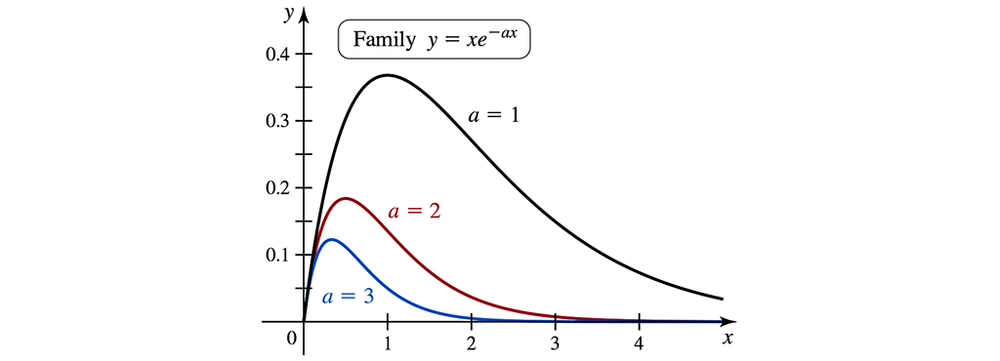
82. A family of exponentials The curves y = x * e^(-a * x) are shown in the figure for a = 1, 2, and 3.
c. Find the area of the region bounded by y = x * e^(-a * x) and the x-axis on the interval [0, b]. Because this area depends on a and b, we call it A(a, b).
Problem 8.2.49c
49. Explain why or why not Determine whether the following statements are true and give an explanation or counterexample:
c. ∫ v du = u·v - ∫ u dv
Problem 8.9.109c
109. Escape velocity and black holes The work required to launch an object from the surface of Earth to outer space is given by W = ∫ from R to ∞ of F(x) dx, where R = 6370 km is the approximate radius of Earth, F(x) = (GMm)/x² is the gravitational force between Earth and the object, G is the gravitational constant, M is the mass of Earth, m is the mass of the object, and GM = 4 × 10¹⁴ m³/s².
c. The French scientist Laplace anticipated the existence of black holes in the 18th century with the following argument: If a body has an escape velocity that equals or exceeds the speed of light, c = 300,000 km/s, then light cannot escape the body and it cannot be seen. Show that such a body has a radius R ≤ 2GM/c². For Earth to be a black hole, what would its radius need to be?
Problem 8.3.71c
Prove the following orthogonality relations (which are used to generate Fourier series). Assume m and n are integers with m ≠ n.
c.
π
∫ sin(mx) cos(nx) dx = 0, when |m + n| is even
0
Problem 8.5.3c
3. What term(s) should appear in the partial fraction decomposition of a proper rational function with each of the following?
c. A factor of (x² + 2x + 6) in the denominator
Problem 8.6.85d
Explain why or why not Determine whether the following statements are true and give an explanation or counterexample.
d. Using the substitution u = tan(x) in ∫ (tan²x / (tan x - 1)) dx leads to ∫ (u² / (u - 1)) du.
Problem 8.9.101d
101. Many methods needed Show that the integral from ∫(from 0 to ∞)(sqrt(x) * ln x) / (1 + x)^2 dx equals pi, following these steps
d. Evaluate the remaining integral using the change of variables z = sqrt(x)
Problem 8.8.66d
66–71. {Use of Tech} Estimating error Refer to Theorem 8.1 in the following exercises.
66. Let f(x) = cos(x²).
d. Use Theorem 8.1 to find an upper bound on the absolute error in the estimate found in part (a).
Problem 8.5.2d
2. Give an example of each of the following.
d. A repeated irreducible quadratic factor
Problem 8.9.87d
87. Explain why or why not Determine whether the following statements are true and give an explanation or counterexample.
d. If ∫(from 1 to ∞) x^(-p) dx exists, then ∫(from 1 to ∞) x^(-q) dx exists (where q > p).
Problem 8.2.81d
81. Possible and impossible integrals
Let Iₙ = ∫ xⁿ e⁻ˣ² dx, where n is a nonnegative integer.
d. Show that, in general, if n is odd, then Iₙ = -½ e⁻ˣ² pₙ₋₁(x), where pₙ₋₁ is a polynomial of degree n - 1.
Problem 8.8.68d
66–71. {Use of Tech} Estimating error Refer to Theorem 8.1 in the following exercises.
68. Let f(x) = e^(x²).
d. Use Theorem 8.1 to find an upper bound on the absolute error in the estimate found in part (a).
Problem 8.1.65d
Explain why or why not Determine whether the following statements are true and give an explanation or counterexample.
d. ∫(1/eˣ) dx = ln eˣ + C.
Problem 8.9.100d
The Eiffel Tower Property Let R be the region between the curves y = e^(-c·x) and y = -e^(-c·x) on the interval [a, ∞), where a ≥ 0 and c > 0.
The center of mass of R is located at (x̄, 0), where x̄ = [∫(a to ∞) x·e^(-c·x) dx] / [∫(a to ∞) e^(-c·x) dx]
(The profile of the Eiffel Tower is modeled by these two exponential curves; see the Guided Project "The exponential Eiffel Tower")
d. Prove this property holds for any a ≥ 0 and c > 0:
The tangent lines to y = ±e^(-c·x) at x = a always intersect at R's center of mass
(Source: P. Weidman and I. Pinelis, Comptes Rendu, Mechanique, 332, 571-584, 2004)
Problem 8.2.77d
77. Tabular integration Consider the integral ∫ f(x)g(x) dx, where f can be differentiated repeatedly and g can be integrated repeatedly
Let Gₖ represent the result of calculating k indefinite integrals of g (omitting constants of integration).
d. The tabular integration table from part (c) is easily extended to allow for as many steps as necessary in the process of integration by parts.
Evaluate ∫ x² e^(x/2) dx by constructing an appropriate table, and explain why the process terminates after four rows of the table have been filled in.
Problem 8.4.57d
57. Explain why or why not Determine whether the following statements are true and give an explanation or counterexample.
d. The integral ∫ dx/(x² + 4x + 9) cannot be evaluated using a trigonometric substitution.
Problem 8.8.67d
66–71. {Use of Tech} Estimating error Refer to Theorem 8.1 in the following exercises.
67. Let f(x) = √(x³ + 1).
d. Use Theorem 8.1 to find an upper bound on the absolute error in the estimate found in part (a).
Problem 8.5.93d
93. Three start-ups Three cars, A, B, and C, start from rest and accelerate along a line according to the following velocity functions:
vₐ(t) = 88t/(t + 1), v_B(t) = 88t²/(t + 1)², and v_C(t) = 88t²/(t² + 1).
d. Which car ultimately gains the lead and remains in front?