
Ch. 9 - Differential Equations
Briggs - Calculus: Early Transcendentals 3rd Edition
Briggs3rd EditionCalculus: Early TranscendentalsISBN: 9780136847243Not the one you use?Change textbook
Chapter 9, Problem 9.5.29c

27–30. Predator-prey models Consider the following pairs of differential equations that model a predator-prey system with populations x and y. In each case, carry out the following steps.
c. Find the equilibrium points for the system.


x′(t) = −3x + xy, y′(t) = 2y − xy

Verified step by step guidance
1
Write down the system of differential equations clearly: \(x'(t) = -3x + xy\) and \(y'(t) = 2y - xy\).
To find equilibrium points, set both derivatives equal to zero because equilibrium occurs where the populations do not change: \(x'(t) = 0\) and \(y'(t) = 0\).
From \(x'(t) = 0\), we have \(-3x + xy = 0\). Factor this expression to get \(x(-3 + y) = 0\).
From \(y'(t) = 0\), we have \(2y - xy = 0\). Factor this expression to get \(y(2 - x) = 0\).
Solve the system of equations \(x(-3 + y) = 0\) and \(y(2 - x) = 0\) by considering cases where each factor is zero to find all equilibrium points \((x, y)\).

Verified video answer for a similar problem:

This video solution was recommended by our tutors as helpful for the problem above.
Video duration:
2m
Was this helpful?

Key Concepts

Here are the essential concepts you must grasp in order to answer the question correctly.

Equilibrium Points in Differential Equations

Equilibrium points occur where the rates of change of all variables are zero, meaning the system is in a steady state. For a system of differential equations, these points are found by setting each derivative equal to zero and solving the resulting algebraic equations. They represent population levels where predator and prey populations remain constant over time.
Recommended video:
07:39
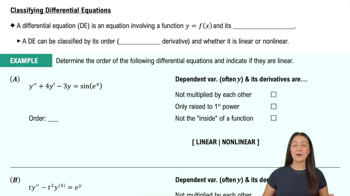
Classifying Differential Equations

Predator-Prey Model Dynamics

Predator-prey models describe interactions between two species where one is the predator and the other the prey. The equations typically include terms representing natural growth or decay and interaction effects, such as predation. Understanding these dynamics helps interpret how populations influence each other and evolve over time.
Recommended video:
09:29
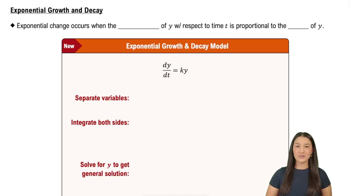
Exponential Growth & Decay

Solving Systems of Nonlinear Equations

Finding equilibrium points often requires solving nonlinear algebraic equations simultaneously. Techniques include substitution or factoring to find all possible solutions. Mastery of these methods is essential to identify all steady states in systems like predator-prey models.
Recommended video:
5:02
Solving Logarithmic Equations
Related Practice
Textbook Question

38–43. Equilibrium solutions A differential equation of the form y′(t)=f(y) is said to be autonomous (the function f depends only on y). The constant function y=y0 is an equilibrium solution of the equation provided f(y0)=0 (because then y'(t)=0 and the solution remains constant for all t). Note that equilibrium solutions correspond to horizontal lines in the direction field. Note also that for autonomous equations, the direction field is independent of t. Carry out the following analysis on the given equations.

c. Sketch the solution curve that corresponds to the initial condition y0=1. 


y′(t) = 2y + 4

51
views
Textbook Question

38–43. Equilibrium solutions A differential equation of the form y′(t)=f(y) is said to be autonomous (the function f depends only on y). The constant function y=y0 is an equilibrium solution of the equation provided f(y0)=0 (because then y'(t)=0 and the solution remains constant for all t). Note that equilibrium solutions correspond to horizontal lines in the direction field. Note also that for autonomous equations, the direction field is independent of t. Carry out the following analysis on the given equations.

c. Sketch the solution curve that corresponds to the initial condition y0=1. 


y′(t) = 6 - 2y

55
views
Textbook Question

{Use of Tech} Free fall Using th e background given in Exercise 47, assume the resistance is given by f(v)=−Rv, for t≥0, where R>0 is a drag coefficient (an assumption often made for a heavy medium such as water or oil).


c. Find the solution of this separable equation assuming v(0)=0 and 0<v<g/b.

51
views
Textbook Question

29–32. {Use of Tech} Errors in Euler’s method Consider the following initial value problems.


c. Which time step results in the more accurate approximation? Explain your observations.


y′(t) = 4−y, y(0) = 3; y(t) = 4−e⁻ᵗ

35
views
Textbook Question

Cooling time Suppose an object with an initial temperature of T₀ > 0 is put in surroundings with an ambient temperature of A, where A < T₀/2. Let t₁/₂ be the time required for the object to cool to T₀/2.


c. Why is the condition A < T₀/2 needed?

49
views
Textbook Question

33–36. {Use of Tech} Computing Euler approximations Use a calculator or computer program to carry out the following steps.

d. Compare the errors in the approximations to y(T).


y′(t) = 6 - 2y, y(0) = -1; Δt = 0.2, T = 3; y(t) = 3 - 4e⁻²ᵗ

54
views