
Textbook Question
Explain why or why not Determine whether the following statements are true and give an explanation or counterexample.
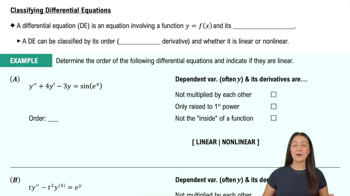
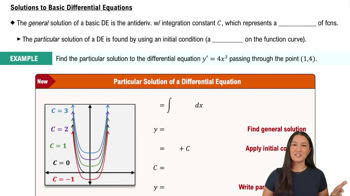
b. Euler’s method is used to compute exact values of the solution of an initial value problem.
62
views

 Verified step by step guidance
 07:39
07:39
 04:00
04:00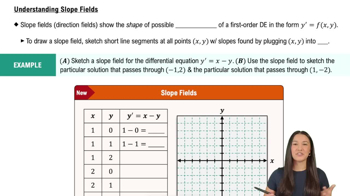 05:45
05:45Explain why or why not Determine whether the following statements are true and give an explanation or counterexample.
b. Euler’s method is used to compute exact values of the solution of an initial value problem.
Explain why or why not Determine whether the following statements are true and give an explanation or counterexample.
b. The solution of a stirred tank initial value problem always approaches a constant as t→∞
Blowup in finite time Consider the initial value problem y'(t) = yⁿ + 1, y(0) = y₀, where n is a positive integer.
b. Solve the initial value problem with n = 2 and y₀ = 1/√2.
23–26. Stirred tank reactions For each of the following stirred tank reactions, carry out the following analysis.
b. Solve the initial value problem.
A one-million-liter pond is contaminated by a chemical pollutant with a concentration of 20 g/L. The source of the pollutant is removed, and pure water is allowed to flow into the pond at a rate of 1200 L/hr. Assuming the pond is thoroughly mixed and drained at a rate of 1200 L/hr, how long does it take to reduce the concentration of the solution in the pond to 10% of the initial value?
17–20. Increasing and decreasing solutions Consider the following differential equations. A detailed direction field is not needed.
b. In what regions are solutions increasing? Decreasing?
y'(t) = y(y+3)(4-y)
38–43. Equilibrium solutions A differential equation of the form y′(t)=f(y) is said to be autonomous (the function f depends only on y). The constant function y=y0 is an equilibrium solution of the equation provided f(y0)=0 (because then y'(t)=0 and the solution remains constant for all t). Note that equilibrium solutions correspond to horizontal lines in the direction field. Note also that for autonomous equations, the direction field is independent of t. Carry out the following analysis on the given equations.
b. Sketch the direction field, for t≥0.
y′(t) = 6 - 2y