Ch. 9 - Differential Equations
Briggs - Calculus: Early Transcendentals 3rd Edition
Briggs3rd EditionCalculus: Early TranscendentalsISBN: 9780136847243Not the one you use?Change textbook
Chapter 9, Problem 9.4.42

39–42. Special equations A special class of first-order linear equations have the form a(t)y'(t)+a'(t)y(t)=f(t), where a and f are given functions of t. Notice that the left side of this equation can be written as the derivative of a product, so the equation has the form
a(t)y'(t) + a'(t)y(t) = d/dt (a(t)y(t)) = f(t). 
Therefore, the equation can be solved by integrating both sides with respect to t. Use this idea to solve the following initial value problems. 


(t² + 1)y′(t) + 2ty = 3t², y(2) = 8

Verified step by step guidance
1
Recognize that the given differential equation is of the form \(a(t)y'(t) + a'(t)y(t) = f(t)\), where \(a(t) = t^2 + 1\) and \(f(t) = 3t^2\).
Rewrite the left side as the derivative of a product: \(\frac{d}{dt} \big(a(t) y(t)\big) = f(t)\), which means \(\frac{d}{dt} \big((t^2 + 1) y(t)\big) = 3t^2\).
Integrate both sides with respect to \(t\): \(\int \frac{d}{dt} \big((t^2 + 1) y(t)\big) dt = \int 3t^2 dt\).
After integration, express the solution as \((t^2 + 1) y(t) = \int 3t^2 dt + C\), where \(C\) is the constant of integration.
Use the initial condition \(y(2) = 8\) to substitute \(t=2\) and \(y=8\) into the equation to solve for \(C\), then write the explicit formula for \(y(t)\) by dividing both sides by \((t^2 + 1)\).

Verified video answer for a similar problem:

This video solution was recommended by our tutors as helpful for the problem above.
Video duration:
4m
Was this helpful?

Key Concepts

Here are the essential concepts you must grasp in order to answer the question correctly.

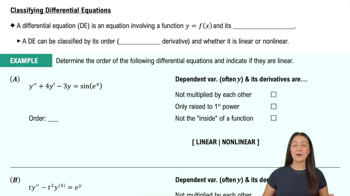
First-Order Linear Differential Equations

These are differential equations of the form y' + p(t)y = q(t), where p and q are functions of t. They can often be solved using integrating factors or by recognizing patterns that simplify the equation, such as rewriting the left side as a derivative of a product.
Recommended video:
07:39
Classifying Differential Equations

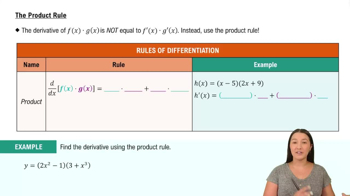
Product Rule and Recognizing Derivatives of Products

The product rule states that d/dt [a(t)y(t)] = a(t)y'(t) + a'(t)y(t). Identifying that the left side of the equation matches this derivative allows rewriting the differential equation in a simpler form, facilitating direct integration.
Recommended video:
05:18
The Product Rule

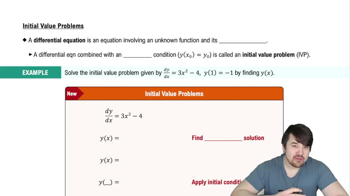
Solving Initial Value Problems by Integration

Once the equation is expressed as d/dt [a(t)y(t)] = f(t), integrating both sides with respect to t yields a(t)y(t) = ∫f(t) dt + C. Applying the initial condition y(t₀) = y₀ helps determine the constant of integration, providing a unique solution.
Recommended video:
05:03
Initial Value Problems