Ch. 9 - Differential Equations
Briggs - Calculus: Early Transcendentals 3rd Edition
Briggs3rd EditionCalculus: Early TranscendentalsISBN: 9780136847243Not the one you use?Change textbook
Chapter 9, Problem 9.4.47

45–48. General first-order linear equations Consider the general first-order linear equation y'(t)+a(t)y(t)=f(t). This equation can be solved, in principle, by defining the integrating factor p(t)=exp(∫a(t)dt). Here is how the integrating factor works. Multiply both sides of the equation by p (which is always positive) and show that the left side becomes an exact derivative. Therefore, the equation becomes


p(t)(y′(t) + a(t)y(t)) = d/dt(p(t)y(t)) = p(t)f(t).


Now integrate both sides of the equation with respect to t to obtain the solution. Use this method to solve the following initial value problems. Begin by computing the required integrating factor.


y′(t) + (2t)/(t² + 1)y(t) = 1 + 3t², y(1) = 4

Verified step by step guidance
1
Identify the given first-order linear differential equation: \(y'(t) + \frac{2t}{t^2 + 1} y(t) = 1 + 3t^2\), with the initial condition \(y(1) = 4\).
Determine the integrating factor \(p(t)\) using the formula \(p(t) = \exp\left(\int a(t) \, dt\right)\), where \(a(t) = \frac{2t}{t^2 + 1}\). So, compute \(p(t) = \exp\left(\int \frac{2t}{t^2 + 1} \, dt\right)\).
Evaluate the integral inside the exponent to find \(p(t)\). Notice that the integral involves a rational function that can be simplified by substitution.
Multiply both sides of the original differential equation by the integrating factor \(p(t)\) to rewrite the left side as the derivative of the product \(p(t) y(t)\): \(\frac{d}{dt} \left(p(t) y(t)\right) = p(t) (1 + 3t^2)\).
Integrate both sides with respect to \(t\) to get \(p(t) y(t) = \int p(t) (1 + 3t^2) \, dt + C\). Then solve for \(y(t)\) by dividing both sides by \(p(t)\), and use the initial condition \(y(1) = 4\) to find the constant \(C\).

Verified video answer for a similar problem:

This video solution was recommended by our tutors as helpful for the problem above.
Video duration:
4m
Was this helpful?

Key Concepts

Here are the essential concepts you must grasp in order to answer the question correctly.

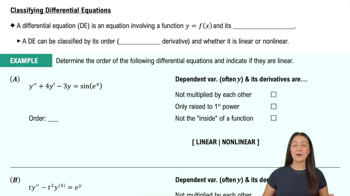
First-Order Linear Differential Equations

A first-order linear differential equation has the form y' + a(t)y = f(t), where a(t) and f(t) are functions of t. Such equations describe many physical and mathematical processes and can be solved systematically using integrating factors. Understanding the structure of these equations is essential for applying solution techniques.
Recommended video:
07:39
Classifying Differential Equations

Integrating Factor Method

The integrating factor is a function p(t) = exp(∫a(t) dt) used to simplify first-order linear equations. Multiplying the entire differential equation by p(t) transforms the left side into the derivative of p(t)y(t), making it easier to integrate both sides. This method converts the equation into an exact derivative form, facilitating straightforward integration.
Recommended video:
07:33
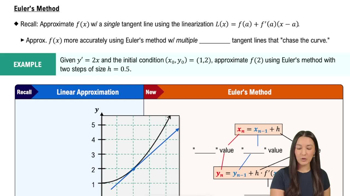
Euler's Method

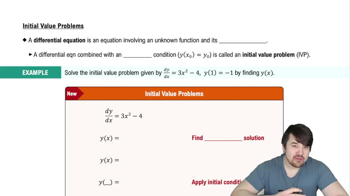
Initial Value Problems (IVP)

An initial value problem specifies the value of the solution y(t) at a particular point t = t₀, such as y(1) = 4. Solving an IVP involves finding the general solution of the differential equation and then using the initial condition to determine the unique constant of integration, ensuring a specific solution that fits the given initial data.
Recommended video:
05:03
Initial Value Problems