Ch. 9 - Differential Equations
Briggs - Calculus: Early Transcendentals 3rd Edition
Briggs3rd EditionCalculus: Early TranscendentalsISBN: 9780136847243Not the one you use?Change textbook
Chapter 9, Problem 9.2.46a

46–48. Analyzing models The following models were discussed in Section 9.1 and reappear in later sections of this chapter. In each case, carry out the indicated analysis using direction fields.
Drug infusion The delivery of a drug (such as an antibiotic) through an intravenous line may be modeled by the differential equation m′(t)+km(t)=I, where m(t) is the mass of the drug in the blood at time t≥0, K is a constant that describes the rate at which the drug is absorbed, and I is the infusion rate. Let I=10mg/hr and k=0.05 hr^−1.
a. Draw the direction field, for 0≤t≤100, 0≤y≤600.

Verified step by step guidance
1
Identify the given differential equation: \(m'(t) + k m(t) = I\), where \(m(t)\) is the mass of the drug in the blood at time \(t\), \(k = 0.05\) hr\(^{-1}\), and \(I = 10\) mg/hr.
Rewrite the differential equation in the standard form for direction fields by isolating \(m'(t)\): \(m'(t) = I - k m(t)\) which becomes \(m'(t) = 10 - 0.05 m(t)\).
Understand that the direction field is a graphical representation of the slope \(m'(t)\) at various points \((t, m)\) in the plane. For each point \((t, m)\), the slope is given by \(10 - 0.05 m\).
Set up a grid of points for \(t\) from 0 to 100 and \(m\) from 0 to 600. At each point, calculate the slope using \(m'(t) = 10 - 0.05 m\) and draw a small line segment with that slope to represent the direction field.
Interpret the direction field: Notice how the slope changes with \(m\). When \(m\) is small, the slope is positive (drug mass increasing), and when \(m\) is large, the slope becomes negative (drug mass decreasing). This helps visualize the behavior of the drug concentration over time.

Verified video answer for a similar problem:

This video solution was recommended by our tutors as helpful for the problem above.
Video duration:
4m
Was this helpful?

Key Concepts

Here are the essential concepts you must grasp in order to answer the question correctly.

Direction Fields

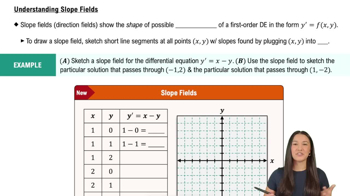
Direction fields, or slope fields, graphically represent solutions to first-order differential equations by showing the slope of the solution curve at various points. Each small line segment indicates the slope given by the differential equation at that point, helping visualize the behavior of solutions without solving the equation explicitly.
Recommended video:
05:45
Understanding Slope Fields

First-Order Linear Differential Equations

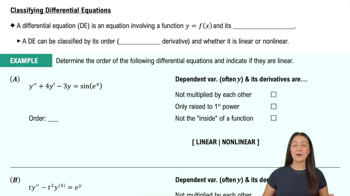
A first-order linear differential equation has the form y' + p(t)y = q(t). It models processes where the rate of change depends linearly on the current state and an external input. Understanding its structure is essential for interpreting the given drug infusion model and predicting how the drug mass changes over time.
Recommended video:
07:39
Classifying Differential Equations

Modeling Drug Infusion with Differential Equations

The drug infusion model m'(t) + km(t) = I describes how the drug mass in the bloodstream changes, balancing infusion rate and absorption. Here, k represents the absorption rate constant, and I the infusion rate. Analyzing this model helps predict drug concentration dynamics and steady-state behavior.
Recommended video:
07:39
Classifying Differential Equations
Related Practice
Textbook Question

Explain why or why not Determine whether the following statements are true and give an explanation or counterexample.

a. The general solution of the differential equation y'(t) = 1 is y(t) = t

38
views

Textbook Question

[Use of Tech] Analysis of a separable equation Consider the differential equation yy'(t) = ½eᵗ + t and carry out the following analysis.

a. Find the general solution of the equation and express it explicitly as a function of t in two cases: y > 0 and y < 0.

44
views
Textbook Question

A physiological model A common assumption in modeling drug assimilation is that the blood volume in a person is a single compartment that behaves like a stirred tank. Suppose the blood volume is a four-liter tank that initially has a zero concentration of a particular drug. At time t = 0, an intravenous line is inserted into a vein (into the tank) that carries a drug solution with a concentration of 500 mg/L. The inflow rate is 0.06 L/min. Assume the drug is quickly mixed thoroughly in the blood and that the volume of blood remains constant.

a. Write an initial value problem that models the mass of the drug in the blood, for t ≥ 0.

48
views
Textbook Question

38–43. Equilibrium solutions A differential equation of the form y′(t)=f(y) is said to be autonomous (the function f depends only on y). The constant function y=y0 is an equilibrium solution of the equation provided f(y0)=0 (because then y'(t)=0 and the solution remains constant for all t). Note that equilibrium solutions correspond to horizontal lines in the direction field. Note also that for autonomous equations, the direction field is independent of t. Carry out the following analysis on the given equations.

a. Find the equilibrium solutions.


y′(t) = 2y + 4

73
views
Textbook Question

Consider the differential equation y'(t)+9y(t)=10.

a. How many arbitrary constants appear in the general solution of the differential equation?

56
views
Textbook Question

38–43. Equilibrium solutions A differential equation of the form y′(t)=f(y) is said to be autonomous (the function f depends only on y). The constant function y=y0 is an equilibrium solution of the equation provided f(y0)=0 (because then y'(t)=0 and the solution remains constant for all t). Note that equilibrium solutions correspond to horizontal lines in the direction field. Note also that for autonomous equations, the direction field is independent of t. Carry out the following analysis on the given equations.

a. Find the equilibrium solutions. 


y′(t) = 6 - 2y

96
views