
Ch. 9 - Differential Equations
Briggs - Calculus: Early Transcendentals 3rd Edition
Briggs3rd EditionCalculus: Early TranscendentalsISBN: 9780136847243Not the one you use?Change textbook
Chapter 9, Problem 9.4.6

5–10. First-order linear equations Find the general solution of the following equations.


y'(x) = −y + 2

Verified step by step guidance
1
Rewrite the differential equation in the standard linear form: \(y'(x) + y = 2\).
Identify the integrating factor \(\mu(x)\), which is given by \(\mu(x) = e^{\int 1 \, dx} = e^{x}\).
Multiply both sides of the equation by the integrating factor to get: \(e^{x} y' + e^{x} y = 2 e^{x}\).
Recognize that the left side is the derivative of the product \(e^{x} y\), so write it as \(\frac{d}{dx} (e^{x} y) = 2 e^{x}\).
Integrate both sides with respect to \(x\): \(\int \frac{d}{dx} (e^{x} y) \, dx = \int 2 e^{x} \, dx\), then solve for \(y\) by dividing by \(e^{x}\) and adding the constant of integration.

Verified video answer for a similar problem:

This video solution was recommended by our tutors as helpful for the problem above.
Video duration:
1m
Was this helpful?

Key Concepts

Here are the essential concepts you must grasp in order to answer the question correctly.

First-Order Linear Differential Equations

A first-order linear differential equation has the form y' + p(x)y = q(x). It involves the first derivative of the unknown function and can be solved using integrating factors or other standard methods. Recognizing this form is essential to apply the correct solution technique.
Recommended video:
07:39
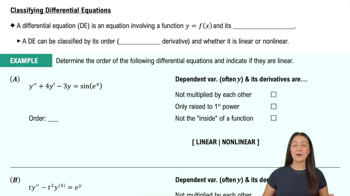
Classifying Differential Equations

Integrating Factor Method

The integrating factor method involves multiplying the entire differential equation by a specially chosen function, usually e^(∫p(x)dx), to rewrite the left side as a derivative of a product. This simplifies solving the equation by allowing direct integration.
Recommended video:
07:33
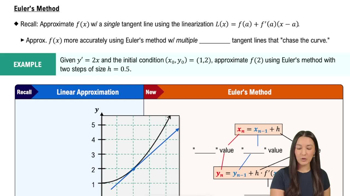
Euler's Method

General Solution of Differential Equations

The general solution includes all possible solutions of a differential equation and typically contains an arbitrary constant. It combines the homogeneous solution (solving y' + p(x)y = 0) and a particular solution to the nonhomogeneous equation.
Recommended video:
04:00
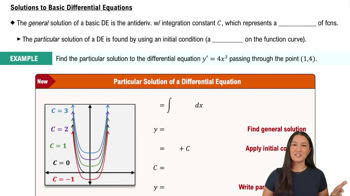
Solutions to Basic Differential Equations
Related Practice
Textbook Question

33–38. {Use of Tech} Solutions in implicit form Solve the following initial value problems and leave the solution in implicit form. Use graphing software to plot the solution. If the implicit solution describes more than one function, be sure to indicate which function corresponds to the solution of the initial value problem.

y'(t) = 2t²/(y² − 1), y(0) = 0

41
views
Textbook Question

21–24. Logistic equations Consider the following logistic equations. In each case, sketch the direction field, draw the solution curve for each initial condition, and find the equilibrium solutions. A detailed direction field is not needed. Assume t ≥ 0 and tP ≥ 0.

P′(t) = 0.05P − 0.001P²; P(0) = 10, P(0) = 40, P(0) = 80

44
views
Textbook Question

21–24. Logistic equations Consider the following logistic equations. In each case, sketch the direction field, draw the solution curve for each initial condition, and find the equilibrium solutions. A detailed direction field is not needed. Assume t ≥ 0 and tP ≥ 0.

P′(t) = 0.05P(1−P/800); P(0) = 100, P(0) = 400, P(0) = 700

57
views
Textbook Question

Consider the differential equation y'(t) = t² - 3y² and the solution curve that passes through the point (3, 1). What is the slope of the curve at (3, 1)?

53
views
Textbook Question

What is the equilibrium solution of the equation y'(t) = 3y − 9? Is it stable or unstable?

64
views
Textbook Question

5–16. Solving separable equations Find the general solution of the following equations. Express the solution explicitly as a function of the independent variable.

e⁴ᵗy'(t) = 5

64
views