
Ch. 9 - Differential Equations
Briggs - Calculus: Early Transcendentals 3rd Edition
Briggs3rd EditionCalculus: Early TranscendentalsISBN: 9780136847243Not the one you use?Change textbook
Chapter 9, Problem 9.3.44b

brOrthogonal trajectories Two curves are orthogonal to each other if their tangent lines are perpendicular at each point of intersection. A family of curves forms orthogonal trajectories with another family of curves if each curve in one family is orthogonal to each curve in the other family. Use the following steps to find the orthogonal trajectories of the family of ellipses 2x² + y² = a²


b. The family of trajectories orthogonal to 2x² + y² = a² satisfies the differential equation dy/dx = y/(2x). Why?

Verified step by step guidance
1
Start with the given family of ellipses: \(2x^{2} + y^{2} = a^{2}\). Since \(a\) is a parameter, differentiate both sides implicitly with respect to \(x\) to find the slope \(\frac{dy}{dx}\) of the tangent to the ellipses.
Differentiating implicitly, apply the chain rule: \(\frac{d}{dx}(2x^{2}) + \frac{d}{dx}(y^{2}) = \frac{d}{dx}(a^{2})\). Since \(a\) is constant with respect to \(x\), its derivative is zero.
Calculate each derivative: \(4x + 2y \frac{dy}{dx} = 0\). Solve this equation for \(\frac{dy}{dx}\) to find the slope of the tangent lines to the ellipses.
Rearranging, we get \(2y \frac{dy}{dx} = -4x\), so \(\frac{dy}{dx} = -\frac{4x}{2y} = -\frac{2x}{y}\). This is the slope of the tangent to the original family of curves.
Orthogonal trajectories have tangent lines perpendicular to these, so their slopes satisfy \(m_{1} \cdot m_{2} = -1\). If \(m_{1} = -\frac{2x}{y}\), then the slope of the orthogonal trajectories is \(m_{2} = -\frac{1}{m_{1}} = \frac{y}{2x}\). Hence, the orthogonal trajectories satisfy \(\frac{dy}{dx} = \frac{y}{2x}\).

Verified video answer for a similar problem:

This video solution was recommended by our tutors as helpful for the problem above.
Video duration:
3m
Was this helpful?

Key Concepts

Here are the essential concepts you must grasp in order to answer the question correctly.

Orthogonal Trajectories

Orthogonal trajectories are families of curves that intersect another family at right angles. At each point of intersection, the tangent lines to the curves are perpendicular, meaning their slopes multiply to -1. Finding orthogonal trajectories involves determining a new family of curves whose slopes are negative reciprocals of the original family’s slopes.

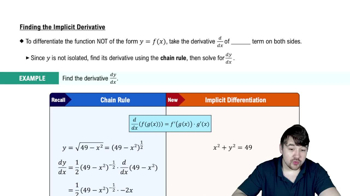
Implicit Differentiation

Implicit differentiation is used to find the derivative dy/dx when y is defined implicitly by an equation involving both x and y. By differentiating both sides of the equation with respect to x and applying the chain rule, we can express dy/dx in terms of x and y, which is essential for analyzing the slope of the given family of curves.
Recommended video:
05:14
Finding The Implicit Derivative

Slope Relationship for Orthogonal Curves

If two curves are orthogonal, their slopes at the point of intersection satisfy the relation m1 * m2 = -1, where m1 and m2 are the slopes of the tangent lines. Given the slope of the original family, the slope of the orthogonal trajectories is the negative reciprocal. This relationship explains why the differential equation for the orthogonal trajectories is derived by taking the negative reciprocal of the original slope.
Recommended video:
05:45
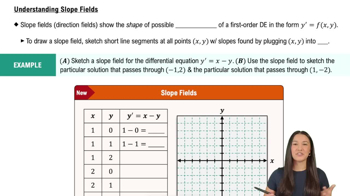
Understanding Slope Fields
Related Practice
Textbook Question

42–43. Implicit solutions for separable equations For the following separable equations, carry out the indicated analysis.

b. Find the value of the arbitrary constant associated with each initial condition. (Each initial condition requires a different constant.)


y'(t) = t²/(y² + 1); y(−1) = 1, y(0) = 0, y(−1) = −1

79
views
Textbook Question

52-56. In this section, several models are presented and the solution of the associated differential equation is given. Later in the chapter, we present methods for solving these differential equations.


{Use of Tech} Drug infusion The delivery of a drug (such as an antibiotic) through an intravenous line may be modeled by the differential equation m'(t) + km(t) = I, where m(t) is the mass of the drug in the blood at time t ≥ 0, k is a constant that describes the rate at which the drug is absorbed, and I is the infusion rate.


b. Graph the solution for I = 10 mg/hr and k = 0.05 hr⁻¹.

36
views
Textbook Question

A bad loan Consider a loan repayment plan described by the initial value problem

B'(t)=0.03B−600,B(0)=40,000,

where the amount borrowed is B(0)=\$40,000, the monthly payments are \$600, and B(t) is the unpaid balance in the loan.

b. What is the most that you can borrow under the terms of this loan without going further into debt each month?

49
views
Textbook Question

27–30. Predator-prey models Consider the following pairs of differential equations that model a predator-prey system with populations x and y. In each case, carry out the following steps.

b. Find the lines along which x'(t) = 0. Find the lines along which y'(t) = 0.


x′(t) = 2x − xy, y′(t) = −y + xy

51
views
Textbook Question

29–32. {Use of Tech} Errors in Euler’s method Consider the following initial value problems.


b. Using the exact solution given, compute the errors in the Euler approximations at t=0.2 and t=0.4.


y′(t) = 2t + 1, y(0) = 0; y(t) = t² + t

67
views
Textbook Question

{Use of Tech} Torricelli’s law An open cylindrical tank initially filled with water drains through a hole in the bottom of the tank according to Torricelli’s law (see figure). If h(t) is the depth of water in the tank for t≥0 s, then Torricelli’s law implies h′(t)=−k√h, where k is a constant that includes g=9.8m/s², the radius of the tank, and the radius of the drain. Assume the initial depth of the water is h(0)=Hm. 

b. Find the solution in k=0.1the case that and H=0.5m. 

94
views