
Ch. 9 - Differential Equations
Briggs - Calculus: Early Transcendentals 3rd Edition
Briggs3rd EditionCalculus: Early TranscendentalsISBN: 9780136847243Not the one you use?Change textbook
Chapter 9, Problem 9.2.45b

Euler’s method on more general grids Suppose the solution of the initial value problem y'(t)=f(t,y),y(a)=A is to be approximated on the interval [a, b].
b. Write the first step of Euler’s method to compute u1.

Verified step by step guidance
1
Recall that Euler's method is a numerical technique to approximate the solution of the initial value problem \(y'(t) = f(t, y)\) with initial condition \(y(a) = A\) over the interval \([a, b]\).
Choose a step size \(h = t_1 - t_0\), where \(t_0 = a\) and \(t_1\) is the next point in the grid where we want to approximate the solution.
The first approximation \(u_0\) is given by the initial condition: \(u_0 = A\).
Use the Euler's method formula to compute the next value \(u_1\): \[u_1 = u_0 + h \cdot f(t_0, u_0)\]
This formula means you take the current value \(u_0\) and add the product of the step size \(h\) and the slope \(f(t_0, u_0)\) to estimate the solution at \(t_1\).

Verified video answer for a similar problem:

This video solution was recommended by our tutors as helpful for the problem above.
Video duration:
3m
Was this helpful?

Key Concepts

Here are the essential concepts you must grasp in order to answer the question correctly.

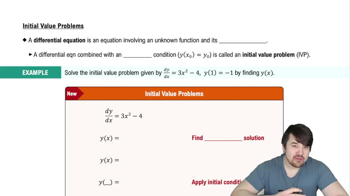
Initial Value Problem (IVP)

An initial value problem involves finding a function y(t) that satisfies a differential equation y'(t) = f(t, y) along with a given initial condition y(a) = A. The solution is sought over an interval [a, b], starting from the known initial value.
Recommended video:
05:03
Initial Value Problems

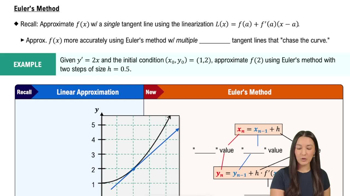
Euler’s Method

Euler’s method is a numerical technique to approximate solutions of differential equations by using tangent line approximations. Starting from the initial point, it estimates the next value by moving along the slope given by f(t, y) multiplied by a step size.
Recommended video:
07:33
Euler's Method

Step Size and Grid Points

The interval [a, b] is divided into discrete points called a grid, where the step size determines the distance between these points. In Euler’s method, the step size affects the accuracy of the approximation, and the first step computes u1 using the initial value and the slope at the initial point.
Recommended video:
04:50
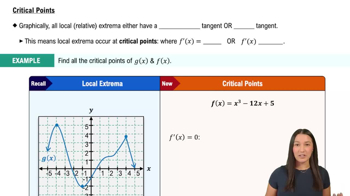
Critical Points
Related Practice
Textbook Question

29–32. {Use of Tech} Errors in Euler’s method Consider the following initial value problems.


b. Using the exact solution given, compute the errors in the Euler approximations at t=0.2 and t=0.4.


y′(t) = −y, y(0) = 1; y(t) = e⁻ᵗ

63
views
Textbook Question

42–43. Implicit solutions for separable equations For the following separable equations, carry out the indicated analysis.

b. Find the value of the arbitrary constant associated with each initial condition. (Each initial condition requires a different constant.)


y'(t) = t²/(y² + 1); y(−1) = 1, y(0) = 0, y(−1) = −1

79
views
Textbook Question

{Use of Tech} Intravenous drug dosing The amount of drug in the blood of a patient (in milligrams) administered via an intravenous line is governed by the initial value problem y’(t) = -0.02y + 3, y(0) = 0 where t is measured in hours.


b. What is the steady-state level of the drug?

38
views
Textbook Question

Explain why or why not Determine whether the following statements are true and give an explanation or counterexample


b. If k>0 and b>0 then y(t)=0 is never a solution of y'(t)=ky−b.

44
views
Textbook Question

27–30. Predator-prey models Consider the following pairs of differential equations that model a predator-prey system with populations x and y. In each case, carry out the following steps.

b. Find the lines along which x'(t) = 0. Find the lines along which y'(t) = 0.


x′(t) = 2x − xy, y′(t) = −y + xy

51
views
Textbook Question

{Use of Tech} Torricelli’s law An open cylindrical tank initially filled with water drains through a hole in the bottom of the tank according to Torricelli’s law (see figure). If h(t) is the depth of water in the tank for t≥0 s, then Torricelli’s law implies h′(t)=−k√h, where k is a constant that includes g=9.8m/s², the radius of the tank, and the radius of the drain. Assume the initial depth of the water is h(0)=Hm. 

b. Find the solution in k=0.1the case that and H=0.5m. 

94
views