
Ch. 9 - Differential Equations
Briggs - Calculus: Early Transcendentals 3rd Edition
Briggs3rd EditionCalculus: Early TranscendentalsISBN: 9780136847243Not the one you use?Change textbook
Chapter 9, Problem 9.3.41c

Explain why or why not Determine whether the following statements are true and give an explanation or counterexample.
c. The general solution of the equation yy'(x) = xe⁻ʸ can be found using integration by parts.

Verified step by step guidance
1
First, rewrite the given differential equation in a more explicit form: \(y \cdot y'(x) = x e^{-y}\), where \(y'(x) = \frac{dy}{dx}\).
Recognize that the equation involves both \(y\) and its derivative \(y'\), and the right side contains \(x\) and an exponential function of \(-y\).
Check if the equation can be separated into variables, i.e., express it as a product of a function of \(y\) and a function of \(x\) to integrate both sides separately.
Integration by parts is a technique used to integrate products of functions with respect to a single variable, typically in the form \(\int u \, dv = uv - \int v \, du\). Since this is a differential equation involving \(y\) and \(x\), integration by parts is not directly applicable to solve it.
Instead, try to separate variables or use substitution methods to solve the equation. For example, rewrite as \(y \frac{dy}{dx} = x e^{-y}\), then rearrange to \(y e^{y} dy = x dx\) if possible, and integrate both sides accordingly.

Verified video answer for a similar problem:

This video solution was recommended by our tutors as helpful for the problem above.
Video duration:
1m
Was this helpful?

Key Concepts

Here are the essential concepts you must grasp in order to answer the question correctly.

Differential Equations and General Solutions

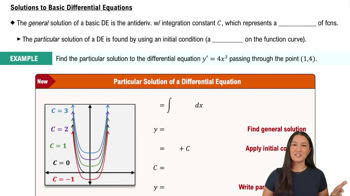
A differential equation relates a function and its derivatives. The general solution includes all possible solutions and often contains arbitrary constants. Understanding how to find the general solution is essential to determine if a particular method applies.
Recommended video:
04:00
Solutions to Basic Differential Equations

Integration by Parts

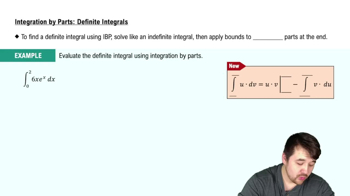
Integration by parts is a technique derived from the product rule for differentiation, used to integrate products of functions. It transforms an integral into simpler parts but is typically applied to integrals, not directly to differential equations.
Recommended video:
06:18
Integration by Parts for Definite Integrals

Methods for Solving First-Order Differential Equations

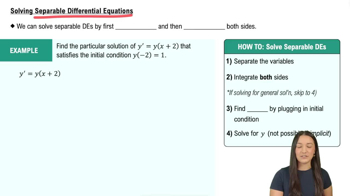
First-order differential equations can be solved using methods like separation of variables, integrating factors, or substitution. Recognizing the equation type helps decide the appropriate method, and integration by parts is generally not a direct method for solving such equations.
Recommended video:
06:06
Solving Separable Differential Equations
Related Practice
Textbook Question

33–36. {Use of Tech} Computing Euler approximations Use a calculator or computer program to carry out the following steps.

c. Repeating parts (a) and (b) using half the time step used in those calculations, again find an approximation to y(T).


y′(t) = 6 - 2y, y(0) = -1; Δt = 0.2, T = 3; y(t) = 3 - 4e⁻²ᵗ

44
views
Textbook Question

{Use of Tech} Logistic equation for an epidemic When an infected person is introduced into a closed and otherwise healthy community, the number of people who contract the disease (in the absence of any intervention) may be modeled by the logistic equation

 dP/dt=kP(1−P/A),P0=P_0, 

where K is a positive infection rate, A is the number of people in the community, and P0 is the number of infected people at t=0. The model also assumes no recovery. 


c. For a fixed value of K and A, describe the long-term behavior of the solutions, for any P0 with 0<P0<A. 

53
views
Textbook Question

46–48. Analyzing models The following models were discussed in Section 9.1 and reappear in later sections of this chapter. In each case, carry out the indicated analysis using direction fields.


Drug infusion The delivery of a drug (such as an antibiotic) through an intravenous line may be modeled by the differential equation m′(t)+km(t)=I, where m(t) is the mass of the drug in the blood at time t≥0, K is a constant that describes the rate at which the drug is absorbed, and I is the infusion rate. Let I=10mg/hr and k=0.05 hr^−1.

c. What is the equilibrium solution?

66
views
Textbook Question

27–30. Predator-prey models Consider the following pairs of differential equations that model a predator-prey system with populations x and y. In each case, carry out the following steps.


c. Find the equilibrium points for the system.


x′(t) = −3x + 6xy, y′(t) = y − 4xy

52
views
Textbook Question

{Use of Tech} Tumor growth The Gompertz growth equation is often used to model the growth of tumors. Let M(t) be the mass of a tumor at time t≥0. The relevant initial value problem is 

dM/dt=−rM ln(M/K),M(0)=M0, 

where r and K are positive constants and 0<M0<K.

b. Solve the initial value problem and graph the solution for r=1,K=4, and M0=1. Describe the growth pattern of the tumor. Is the growth unbounded? If not, what is the limiting size of the tumor? 

55
views
Textbook Question

52-56. In this section, several models are presented and the solution of the associated differential equation is given. Later in the chapter, we present methods for solving these differential equations.


{Use of Tech} Free fall One possible model that describes the free fall of an object in a gravitational field subject to air resistance uses the equation v'(t) = g - bv, where v(t) is the velocity of the object for t ≥ 0, g = 9.8 m/s² is the acceleration due to gravity, and b > 0 is a constant that involves the mass of the object and the air resistance.


c. Using the graph in part (b), estimate the terminal velocity lim(t→∞) v(t).

43
views