
Ch. 9 - Differential Equations
Briggs - Calculus: Early Transcendentals 3rd Edition
Briggs3rd EditionCalculus: Early TranscendentalsISBN: 9780136847243Not the one you use?Change textbook
Chapter 9, Problem 9.3.50b

{Use of Tech} Chemical rate equations Let y(t) be t he concentration of a substance in a chemical reaction (typical units are moles/liter). The change in the concentration, under appropriate conditions, is modeled by the equation dy/dt=-ky^n for t≥0, where k>0 is a rate constant and the positive integer n is the order of the reaction.
b. Solve the initial value problem for a second-order reaction (n=2) assuming y(0)=y0.

Verified step by step guidance
1
Identify the given differential equation for the second-order reaction: \(\frac{dy}{dt} = -k y^{2}\), where \(k > 0\) and the initial condition is \(y(0) = y_0\).
Rewrite the differential equation to separate variables, moving all terms involving \(y\) to one side and \(t\) to the other: \(\frac{dy}{y^{2}} = -k \, dt\).
Integrate both sides: integrate \(\int \frac{dy}{y^{2}}\) with respect to \(y\) and \(\int -k \, dt\) with respect to \(t\).
After integration, apply the initial condition \(y(0) = y_0\) to solve for the constant of integration.
Finally, solve the resulting equation for \(y\) explicitly as a function of \(t\) to express the concentration \(y(t)\).

Verified video answer for a similar problem:

This video solution was recommended by our tutors as helpful for the problem above.
Video duration:
3m
Was this helpful?

Key Concepts

Here are the essential concepts you must grasp in order to answer the question correctly.

Separable Differential Equations

A separable differential equation can be written as dy/dt = g(t)h(y), allowing variables y and t to be separated on opposite sides. This enables integration with respect to each variable independently, which is essential for solving equations like dy/dt = -ky^n.
Recommended video:
06:06
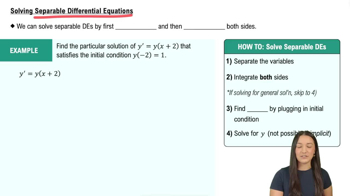
Solving Separable Differential Equations

Initial Value Problem (IVP)

An initial value problem specifies the value of the unknown function at a particular point, such as y(0) = y0. This condition allows us to find the particular solution to a differential equation that fits the given starting concentration.
Recommended video:
05:03
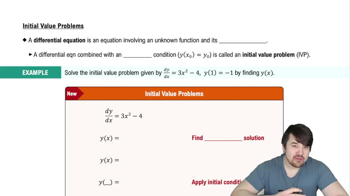
Initial Value Problems

Second-Order Reaction Rate Law

For a second-order reaction (n=2), the rate equation is dy/dt = -ky^2. Solving this involves integrating the reciprocal of y squared, leading to a solution that describes how concentration decreases over time, typically resulting in a rational function of t.
Recommended video:
06:35
Changing Geometries
Related Practice
Textbook Question

38–43. Equilibrium solutions A differential equation of the form y′(t)=f(y) is said to be autonomous (the function f depends only on y). The constant function y=y0 is an equilibrium solution of the equation provided f(y0)=0 (because then y'(t)=0 and the solution remains constant for all t). Note that equilibrium solutions correspond to horizontal lines in the direction field. Note also that for autonomous equations, the direction field is independent of t. Carry out the following analysis on the given equations.

a. Find the equilibrium solutions. 


y′(t) = y(y - 3)(y + 2)

78
views
Textbook Question

23–26. Stirred tank reactions For each of the following stirred tank reactions, carry out the following analysis.

a. Write an initial value problem for the mass of the substance.


A one-million-liter pond is contaminated by a chemical pollutant with a concentration of 20 g/L. The source of the pollutant is removed, and pure water is allowed to flow into the pond at a rate of 1200 L/hr. Assuming the pond is thoroughly mixed and drained at a rate of 1200 L/hr, how long does it take to reduce the concentration of the solution in the pond to 10% of the initial value?

36
views
Textbook Question

Direction field analysis Consider the first-order initial value problem y'(t)=ay+b,y(0)=A for t≥0 where a, b, and A are real numbers.

a. Explain why y=−b/a is an equilibrium solution and corresponds to a horizontal line in the direction field.

57
views
Textbook Question

52-56. In this section, several models are presented and the solution of the associated differential equation is given. Later in the chapter, we present methods for solving these differential equations.


{Use of Tech} Drug infusion The delivery of a drug (such as an antibiotic) through an intravenous line may be modeled by the differential equation m'(t) + km(t) = I, where m(t) is the mass of the drug in the blood at time t ≥ 0, k is a constant that describes the rate at which the drug is absorbed, and I is the infusion rate.


b. Graph the solution for I = 10 mg/hr and k = 0.05 hr⁻¹.

36
views
Textbook Question

A bad loan Consider a loan repayment plan described by the initial value problem

B'(t)=0.03B−600,B(0)=40,000,

where the amount borrowed is B(0)=\$40,000, the monthly payments are \$600, and B(t) is the unpaid balance in the loan.

b. What is the most that you can borrow under the terms of this loan without going further into debt each month?

49
views
Textbook Question

Convergence of Euler's method Suppose Euler's method is applied to the initial value problem y′(t) = ay, y(0) = 1, which has the exact solution y(t) = eᵃᵗ. For this exercise, let h denote the time step (rather than Δt). The grid points are then given by tₖ = kh. We let uₖ be the Euler approximation to the exact solution y(tₖ), for k = 0, 1, 2, ...

b. Show by substitution that uₖ = (1 + ah)ᵏ is a solution of the equations in part (a), for k = 0, 1, 2, ...

65
views