Express the polar equation r=f(θ) in parametric form in Cartesian coordinates, where θ is the parameter.
Ch.12 - Parametric and Polar Curves
Briggs3rd EditionCalculus: Early TranscendentalsISBN: 9780136847243Not the one you use?Change textbook
Chapter 12, Problem 12.2.33
31–36. Converting coordinates Express the following Cartesian coordinates in polar coordinates in at least two different ways.
(1, √3)
Verified step by step guidance1
Recall the formulas to convert Cartesian coordinates \((x, y)\) to polar coordinates \((r, \theta)\):
\(r = \sqrt{x^2 + y^2}\)
\(\theta = \arctan\left(\frac{y}{x}\right)\)
Calculate the radius \(r\) by substituting \(x = 1\) and \(y = \sqrt{3}\) into the formula:
\(r = \sqrt{1^2 + (\sqrt{3})^2}\)
Calculate the angle \(\theta\) using the arctangent formula:
\(\theta = \arctan\left(\frac{\sqrt{3}}{1}\right)\)
Express the polar coordinates as \((r, \theta)\) using the values found in steps 2 and 3.
For the second way, express the angle \(\theta\) in degrees instead of radians or use a known angle value (e.g., \(\theta = \frac{\pi}{3}\) radians or \(60^\circ\)) to write the polar coordinates as \((r, \theta)\).

Verified video answer for a similar problem:
This video solution was recommended by our tutors as helpful for the problem above.
Video duration:
4mWas this helpful?
Key Concepts
Here are the essential concepts you must grasp in order to answer the question correctly.
Cartesian and Polar Coordinate Systems
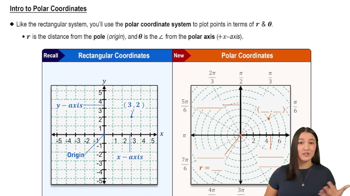
Cartesian coordinates represent points using (x, y) values on perpendicular axes, while polar coordinates describe points by their distance from the origin (r) and the angle (θ) from the positive x-axis. Understanding both systems is essential for converting between them.
Recommended video:
Intro to Polar Coordinates
Conversion Formulas Between Cartesian and Polar Coordinates
To convert from Cartesian (x, y) to polar (r, θ), use r = √(x² + y²) to find the radius and θ = arctan(y/x) to find the angle. Adjust θ based on the quadrant to get the correct direction.
Recommended video:
Intro to Polar Coordinates
Multiple Representations of Polar Coordinates
Polar coordinates are not unique; the same point can be represented by adding multiples of 2π to θ or by using negative r values with adjusted angles. Recognizing these alternatives allows expressing coordinates in at least two different valid ways.
Recommended video:
Intro to Polar Coordinates
Related Practice
Textbook Question
74
views
Textbook Question
45–60. Areas of regions Find the area of the following regions.
The region common to the circles r = 2 sin θ and r = 1
70
views
Textbook Question
37–52. Curves to parametric equations Find parametric equations for the following curves. Include an interval for the parameter values. Answers are not unique.
The upper half of the parabola x=y ², originating at (0, 0)
51
views
Textbook Question
Parabola-hyperbola tangency: Let P be the parabola y = px² and H be the right half of the hyperbola x² - y² = 1.
b. At what point does the tangency occur?
45
views
Textbook Question
75–76. Graphs to polar equations Find a polar equation for each conic section. Assume one focus is at the origin.
91
views
Textbook Question
57–64. Graphing polar curves Graph the following equations. Use a graphing utility to check your work and produce a final graph.
r = 2 - 2 sin θ b
52
views