Tangent line at the origin Find the polar equation of the line tangent to the polar curve r=4cosθ at the origin. Explain why the slope of this line is undefined.
Ch.12 - Parametric and Polar Curves
Briggs3rd EditionCalculus: Early TranscendentalsISBN: 9780136847243Not the one you use?Change textbook
Chapter 12, Problem 12.4.50
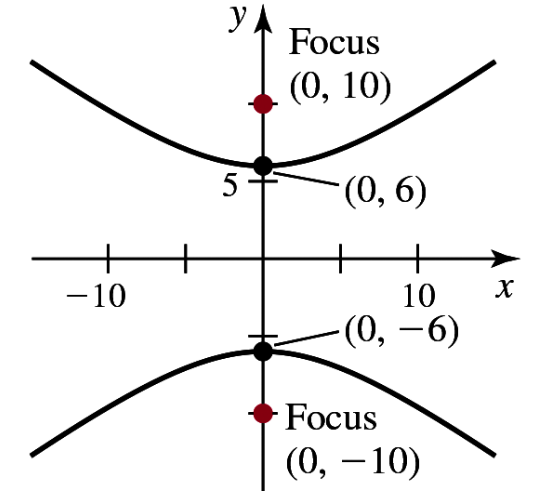
39–50. Equations of ellipses and hyperbolas Find an equation of the following ellipses and hyperbolas, assuming the center is at the origin.

Verified step by step guidance1
Identify the type of conic section: Since the graph shows a hyperbola centered at the origin with vertices and foci along the y-axis, it is a vertical hyperbola.
Recall the standard form of the equation for a hyperbola centered at the origin with a vertical transverse axis: \(\frac{y^2}{a^2} - \frac{x^2}{b^2} = 1\).
Determine the value of \(a\): The vertices are at \((0, 6)\) and \((0, -6)\), so the distance from the center to each vertex is \(a = 6\), which means \(a^2 = 36\).
Determine the value of \(c\): The foci are at \((0, 10)\) and \((0, -10)\), so the distance from the center to each focus is \(c = 10\), which means \(c^2 = 100\).
Use the relationship between \(a\), \(b\), and \(c\) for hyperbolas: \(c^2 = a^2 + b^2\). Substitute the known values to solve for \(b^2\): \(100 = 36 + b^2\), then \(b^2 = 100 - 36\).

Verified video answer for a similar problem:
This video solution was recommended by our tutors as helpful for the problem above.
Video duration:
2mWas this helpful?
Key Concepts
Here are the essential concepts you must grasp in order to answer the question correctly.
Standard Equation of a Hyperbola Centered at the Origin
A hyperbola centered at the origin with a vertical transverse axis has the equation \( \frac{y^2}{a^2} - \frac{x^2}{b^2} = 1 \). Here, \(a\) is the distance from the center to each vertex along the y-axis, and \(b\) relates to the distance along the conjugate axis. This form is essential to write the equation based on given vertices and foci.
Recommended video:
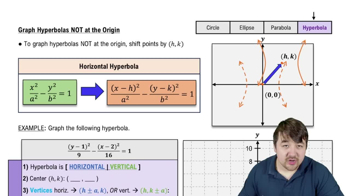
Graph Hyperbolas NOT at the Origin
Relationship Between Vertices, Foci, and Parameters \(a\), \(b\), and \(c\)
In a hyperbola, \(a\) is the distance from the center to each vertex, and \(c\) is the distance from the center to each focus. These satisfy the equation \( c^2 = a^2 + b^2 \). Knowing \(a\) and \(c\) allows calculation of \(b\), which is necessary to complete the hyperbola's equation.
Recommended video:
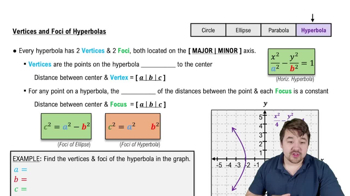
Foci and Vertices of Hyperbolas
Graph Interpretation and Coordinate Identification
Analyzing the graph helps identify key points such as vertices and foci coordinates. For this hyperbola, vertices at (0,6) and (0,-6) give \(a=6\), and foci at (0,10) and (0,-10) give \(c=10\). These values are critical inputs for forming the hyperbola's equation.
Recommended video:
Intro to Polar Coordinates
Related Practice
Textbook Question
94
views
Textbook Question
What is the polar equation of the horizontal line y = 5?
85
views
Textbook Question
15–30. Working with parametric equations Consider the following parametric equations.
a. Eliminate the parameter to obtain an equation in x and y.
b. Describe the curve and indicate the positive orientation.
x = r − 1, y = r³; −4 ≤ r ≤ 4
50
views
Textbook Question
33–40. Areas of regions Make a sketch of the region and its bounding curves. Find the area of the region.
The region inside the curve r = √(cos θ)
58
views
Textbook Question
31–36. Eliminating the parameter Eliminate the parameter to express the following parametric equations as a single equation in x and y.
x=2 sin 8t, y=2 cos 8t
92
views
Textbook Question
37–48. Polar-to-Cartesian coordinates Convert the following equations to Cartesian coordinates. Describe the resulting curve.
r = 6 cos θ + 8 sin θ
75
views