
Textbook Question
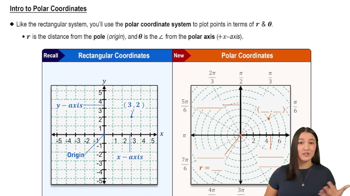
37–48. Polar-to-Cartesian coordinates Convert the following equations to Cartesian coordinates. Describe the resulting curve.
r = sin θ sec² θ
45
views

 Verified step by step guidance
 05:32
05:32 05:32
05:32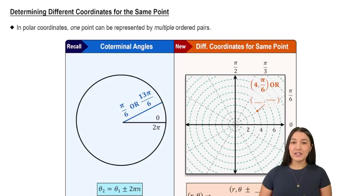 6:02
6:0237–48. Polar-to-Cartesian coordinates Convert the following equations to Cartesian coordinates. Describe the resulting curve.
r = sin θ sec² θ
29–32. Intersection points Use algebraic methods to find as many intersection points of the following curves as possible. Use graphical methods to identify the remaining intersection points.
r = 1 and r = 2 sin 2θ
Explain why the slope of the line θ=π/2 is undefined.
15–30. Working with parametric equations Consider the following parametric equations.
a. Eliminate the parameter to obtain an equation in x and y.
b. Describe the curve and indicate the positive orientation.
x = √t + 4, y = 3√t; 0 ≤ t ≤ 16
45–60. Areas of regions Find the area of the following regions.
The region inside the curve r = √(cos θ) and inside the circle r = 1/√2 in the first quadrant
39–50. Equations of ellipses and hyperbolas Find an equation of the following ellipses and hyperbolas, assuming the center is at the origin.
A hyperbola with vertices (±2, 0) and asymptotes y = ±3x/2