
Ch.12 - Parametric and Polar Curves
Briggs - Calculus: Early Transcendentals 3rd Edition
Briggs3rd EditionCalculus: Early TranscendentalsISBN: 9780136847243Not the one you use?Change textbook
Chapter 12, Problem 12.2.109

Subtle symmetry Without using a graphing utility, determine the symmetries (if any) of the curve r=4-sin (θ/2)

Verified step by step guidance
1
Recall that to determine symmetries of a polar curve \(r = f(\theta)\), we check for symmetry about the polar axis, the line \(\theta = \frac{\pi}{2}\), and the pole (origin).
For symmetry about the polar axis (the horizontal axis), replace \(\theta\) by \(-\theta\) and check if the equation remains unchanged or can be manipulated to the original form. That is, check if \(r = 4 - \sin\left(\frac{-\theta}{2}\right)\) simplifies to the original \(r\).
For symmetry about the line \(\theta = \frac{\pi}{2}\) (vertical axis), replace \(\theta\) by \(\pi - \theta\) and check if the equation remains unchanged or can be manipulated to the original form. That is, check if \(r = 4 - \sin\left(\frac{\pi - \theta}{2}\right)\) simplifies to the original \(r\).
For symmetry about the pole (origin), replace \(r\) by \(-r\) and \(\theta\) by \(\theta + \pi\), and check if the equation holds. That is, check if \(-r = 4 - \sin\left(\frac{\theta + \pi}{2}\right)\) can be rearranged to the original equation.
Analyze the results from these substitutions to conclude which symmetries the curve has based on whether the equation remains equivalent after each transformation.

Verified video answer for a similar problem:

This video solution was recommended by our tutors as helpful for the problem above.
Video duration:
4m
Was this helpful?

Key Concepts

Here are the essential concepts you must grasp in order to answer the question correctly.

Polar Coordinates and Polar Equations

Polar coordinates represent points using a radius and an angle, with equations expressing relationships between r (radius) and θ (angle). Understanding how to interpret and manipulate polar equations is essential for analyzing curves defined in this system.
Recommended video:
05:32
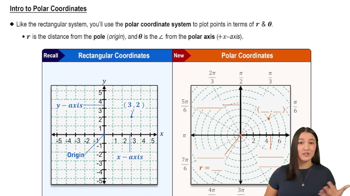
Intro to Polar Coordinates

Symmetry in Polar Graphs

Symmetry in polar graphs can be tested by checking if the equation remains unchanged under transformations: θ replaced by -θ (symmetry about the polar axis), θ replaced by π - θ (symmetry about the vertical line θ = π/2), or r replaced by -r with θ replaced by θ + π (symmetry about the pole).
Recommended video:
05:32
Intro to Polar Coordinates

Trigonometric Function Properties

Understanding the properties of sine functions, especially with angle transformations like θ/2, helps determine how the function behaves under angle shifts or reflections. This is crucial for testing symmetry without graphing tools.
Recommended video:
06:21
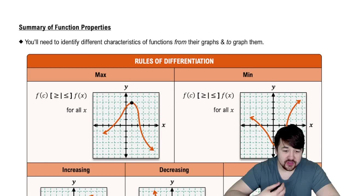
Properties of Functions
Related Practice
Textbook Question

85–87. Grazing goat problems Consider the following sequence of problems related to grazing goats tied to a rope. (See the Guided Project Grazing goat problems.)


A circular corral of unit radius is enclosed by a fence. A goat is outside the corral and tied to the fence with a rope of length 0≤a ≤ π (see figure). What is the area of the region (outside the corral) that the goat can reach?


47
views
Textbook Question

31–36. Converting coordinates Express the following Cartesian coordinates in polar coordinates in at least two different ways.


(-4, 4√3)

81
views
Textbook Question

63–74. Arc length of polar curves Find the length of the following polar curves.


The spiral r = θ², for 0 ≤ θ ≤ 2π

66
views
Textbook Question

23–24. Radar Airplanes are equipped with transponders that allow air traffic controllers to see their locations on radar screens. Radar gives the distance of the plane from the radar station (located at the origin) and the angular position of the plane, typically measured in degrees clockwise from north.

A plane is 50 miles from a radar station at an angle of 10 dgeree clockwise from north. Find polar coordinates for the location of the plane.

53
views
Textbook Question

9–13. Graph the points with the following polar coordinates. Give two alternative representations of the points in polar coordinates.


(-1, -π/3)

70
views
Textbook Question

49–52. Cartesian-to-polar coordinates Convert the following equations to polar coordinates.


(x - 1)² + y² = 1

71
views