Ch.12 - Parametric and Polar Curves
Briggs - Calculus: Early Transcendentals 3rd Edition
Briggs3rd EditionCalculus: Early TranscendentalsISBN: 9780136847243Not the one you use?Change textbook
Chapter 12, Problem 12.3.8

Without calculating derivatives, determine the slopes of each of the lines tangent to the curve r=8 cos θ−4 at the origin.

Verified step by step guidance
1
Recognize that the curve is given in polar form as \(r = 8 \cos \theta - 4\). To find the slopes of tangent lines at the origin, we need to find the values of \(\theta\) where the curve passes through the origin, i.e., where \(r = 0\).
Set \(r = 0\) and solve for \(\theta\): \(0 = 8 \cos \theta - 4\). Rearranging gives \(8 \cos \theta = 4\), so \(\cos \theta = \frac{1}{2}\).
Find the values of \(\theta\) that satisfy \(\cos \theta = \frac{1}{2}\). These are \(\theta = \frac{\pi}{3}\) and \(\theta = \frac{5\pi}{3}\) (within one full rotation \(0 \leq \theta < 2\pi\)).
Recall that the slope of the tangent line to a polar curve at a point where \(r \neq 0\) is given by \(\frac{dy}{dx} = \frac{r' \sin \theta + r \cos \theta}{r' \cos \theta - r \sin \theta}\), where \(r' = \frac{dr}{d\theta}\). However, since the problem asks to avoid calculating derivatives, use the geometric fact that at the origin, the tangent lines correspond to the lines passing through the origin at angles \(\theta\) where \(r=0\).
Therefore, the slopes of the tangent lines at the origin are the slopes of lines making angles \(\theta = \frac{\pi}{3}\) and \(\theta = \frac{5\pi}{3}\) with the positive x-axis. Use \(\text{slope} = \tan \theta\) to find the slopes of these tangent lines.

Verified video answer for a similar problem:

This video solution was recommended by our tutors as helpful for the problem above.
Video duration:
4m
Was this helpful?

Key Concepts

Here are the essential concepts you must grasp in order to answer the question correctly.

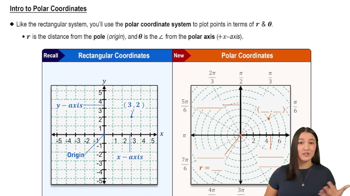
Polar Coordinates and the Curve Equation

Polar coordinates represent points using radius r and angle θ. The given curve r = 8 cos θ − 4 defines the distance from the origin as a function of θ. Understanding how the curve behaves near the origin (r = 0) is essential to find tangent lines there.
Recommended video:
05:32
Intro to Polar Coordinates

Tangent Lines in Polar Coordinates

Tangent lines to a polar curve at the origin correspond to directions where the curve passes through r = 0. At these points, the slope of the tangent line can be found by analyzing the angle θ where r = 0, since the tangent line direction is related to θ at the origin.
Recommended video:
05:32
Intro to Polar Coordinates

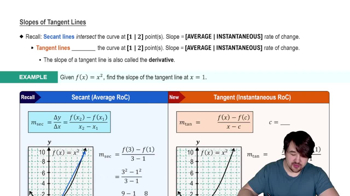
Slope of Tangent Lines Without Derivatives

Without using derivatives, slopes of tangent lines at the origin can be found by converting polar coordinates to Cartesian form and using geometric reasoning. The slope is given by tan(θ) for the tangent line direction at r = 0, where the curve intersects the origin.
Recommended video:
05:13
Slopes of Tangent Lines